Everything about Semiconductor memory
Data storage device
Semiconductor memory is a digital electronic semiconductor device used for digital data storage, such as computer memory. It typically refers to devices in which data is stored within metal–oxide–semiconductor (MOS) memory cells on a silicon integrated circuit memory chip. There are multiple types using different semiconductor technologies. The two main types of random-access memory (RAM) are static RAM (SRAM), which uses several transistors per memory cell, and dynamic RAM (DRAM), which uses a transistor and a MOS capacitor per cell. Non-volatile memory uses floating-gate memory cells, which consist of a single floating-gate transistor per cell. Wikipedia →
🧭 Start here: a 6-step reading path
- Read the overview: Semiconductor memoryA 5-minute orientation
- Skim a recent paper: Review of Semiconductor Flash Memory Devices for Material and Process IssuesInfluential work since 2022
- Pick up a classic book: Sixth Biennial IEEE International Nonvolatile Memory Technology ConferenceThe most-reprinted book on the subject
- Read the landmark paper: Prospective of Semiconductor Memory Devices: from Memory System to MaterialsCited 240 times
- Go sideways: Computer memoryA closely related topic
- Go sideways: Memory cell (computing)A closely related topic
📖 Definitions
Noun Any device used to store and retrieve digital information that is manufactured using integrated circuit technology.
🗂️ The subject at a glance
🏆 Landmark papers (most cited)
Prospective of Semiconductor Memory Devices: from Memory System to Materials
A Semiconductor-Based Photonic Memory Cell
Nonvolatile semiconductor memory devices
Tutorial on semiconductor memory testing
Electrically reprogrammable nonvolatile semiconductor memory
Semiconductor memory trends
Large-capacity semiconductor memory
Semiconductor Memory Road Map: Advances in Semiconductor Memory
🆕 Influential since 2022
Review of Semiconductor Flash Memory Devices for Material and Process Issues
Oxide Semiconductor Memristor‐Based Optoelectronic Synaptic Devices With Quaternary Memory Storage
A Gate Programmable van der Waals Metal‐Ferroelectric‐Semiconductor Vertical Heterojunction Memory
Van der Waals Ferroelectric Semiconductor Field Effect Transistor for In-Memory Computing
Reconfigurable Quasi‐Nonvolatile Memory/Subthermionic FET Functions in Ferroelectric–2D Semiconductor vdW Architectures
📚 Books worth reading
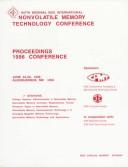 Sixth Biennial IEEE International Nonvolatile Memory Technology ConferenceIEEE International Nonvolatile Memory Technology Conference (6th 1996 Albuquerque, N.M.) · 1996
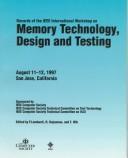 ProceedingsIEEE International Workshop on Memory Technology, Design, and Testing (1997 San Jose, Calif.) · 1997
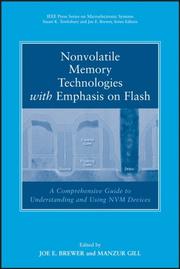 Nonvolatile memory technologies with emphasis on FlashJoe Brewer, Manzur Gill · 2007
 Design Exploration of Emerging Nano-scale Non-volatile MemoryHao Yu, Yuhao Wang · 2014
 Bits on ChipsHarry Veendrick · 2011
 Phase Change MemoryAndrea Redaelli · 2017
- 📕Nonvolatile Memory Semiconductor TechnologyRiichiro Shirota · 2008
- 📕DRAMs of one megabit and above from the Republic of KoreaUnited States International Trade Commission. · 1992
Ranked by number of editions on Open Library, a rough measure of how lasting a book is.
🔗 Related topics
- Computer memory Computer memory stores information, such as data and programs, for immediate use in the computer; instructions fetched by the computer, and data fetched…
- Memory cell (computing) The memory cell is the fundamental building block of computer memory. The memory cell is a device, such as an electronic circuit, that stores one bit of…
- Random-access memory Random-access memory (RAM; /ræm/) is a form of electronic computer memory that can be read and changed in any order, typically used to store working data…
- Dynamic random-access memory Dynamic random-access memory (dynamic RAM or DRAM) is a type of random-access semiconductor memory that stores each bit of data in a memory cell. A DRAM…
- Static random-access memory Static random-access memory (static RAM or SRAM) is a type of random-access memory (RAM) that uses latching circuitry (flip-flop) to store each bit. SRAM…
- Reading (computer) Reading is an action performed by computers, to acquire data from a source and place it into their volatile memory for processing. Computers may read informatio…
- Memory refresh Memory refresh is a process of periodically reading information from an area of computer memory and immediately rewriting the read information to the same…
- Read-only memory Read-only memory (ROM) is a form of non-volatile memory used in computers and other electronic devices. Data stored in ROM cannot be electronically modified…