Everything about Random-access memory
Form of computer memory

Random-access memory is a form of electronic computer memory that can be read and changed in any order, typically used to store working data and machine code. A random-access memory device allows data items to be read or written in almost the same amount of time irrespective of the physical location of data inside the memory, in contrast with other direct-access data storage media, where the time required to read and write data items varies significantly depending on their physical locations on the recording medium, due to mechanical limitations such as media rotation speeds and arm movement. Wikipedia →
🧭 Start here: a 6-step reading path
- Read the overview: Random-access memoryA 5-minute orientation
- Skim a recent paper: A compute-in-memory chip based on resistive random-access memoryInfluential work since 2022
- Pick up a classic book: Advances in Nonvolatile Memory and Storage TechnologyThe most-reprinted book on the subject
- Read the landmark paper: Quantum Random Access MemoryCited 808 times
- Go sideways: Semiconductor memoryA closely related topic
- Go sideways: Memory cell (computing)A closely related topic
📖 Definitions
Noun Alternative form of random access memory.
🗂️ The subject at a glance
🏆 Landmark papers (most cited)
Quantum Random Access Memory
Magnetoresistive Random Access Memory
Resistance random access memory
Molecular random access memory cell
Purely antiferromagnetic magnetoelectric random access memory
Architectures for a quantum random access memory
Future of dynamic random-access memory as main memory
Amorphous ZnO based resistive random access memory
🆕 Influential since 2022
A compute-in-memory chip based on resistive random-access memory
Resistive Switching Random-Access Memory (RRAM): Applications and Requirements for Memory and Computing
A computing-in-memory macro based on three-dimensional resistive random-access memory
Recent progress in spin-orbit torque magnetic random-access memory
Electrical programmable multilevel nonvolatile photonic random-access memory
📚 Books worth reading
 Advances in Nonvolatile Memory and Storage TechnologyYoshio Nishi · 2014
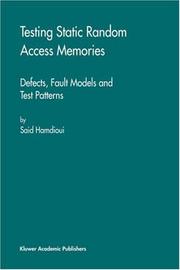 Testing static random access memoriesSaid Hamdioui · 2004
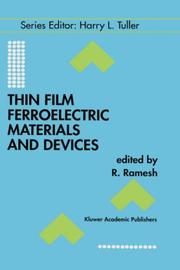 Thin film ferroelectric materials and devicesR. Ramesh · 1997
- 📕BCH codes for large IC random-access memory systemsShu Lin · 1983
 ProceedingsIEEE International Workshop on Memory Technology, Design, and Testing (1997 San Jose, Calif.) · 1997
 Nanometer VariationTolerant SramMohab Anis · 2012
 Design Exploration of Emerging Nano-scale Non-volatile MemoryHao Yu, Yuhao Wang · 2014
 Emerging Memory TechnologiesYuan Xie · 2013
Ranked by number of editions on Open Library, a rough measure of how lasting a book is.
🔗 Related topics
- Semiconductor memory Semiconductor memory is a digital electronic semiconductor device used for digital data storage, such as computer memory. It typically refers to devices…
- Memory cell (computing) The memory cell is the fundamental building block of computer memory. The memory cell is a device, such as an electronic circuit, that stores one bit of…
- Computer memory Computer memory stores information, such as data and programs, for immediate use in the computer; instructions fetched by the computer, and data fetched…
- Dynamic random-access memory Dynamic random-access memory (dynamic RAM or DRAM) is a type of random-access semiconductor memory that stores each bit of data in a memory cell. A DRAM…
- Static random-access memory Static random-access memory (static RAM or SRAM) is a type of random-access memory (RAM) that uses latching circuitry (flip-flop) to store each bit. SRAM…
- Transistor count The transistor count is the number of transistors in an electronic device (typically on a single substrate or silicon die). It is the most common measure…
- Read-only memory Read-only memory (ROM) is a form of non-volatile memory used in computers and other electronic devices. Data stored in ROM cannot be electronically modified…
- Volatile memory Volatile memory, in contrast to non-volatile memory, is computer memory that requires power to maintain the stored information; it retains its contents…