Everything about Propulsion
Means of creating force leading to movement

Propulsion is the generation of force by any combination of pushing and/or pulling to modify the translational motion of an object, which is typically a rigid body but may also concern a fluid. A propulsion system is a machine system consisting of at least two core elements: the powerplant, a source of mechanical power; and the propulsor, an actuator mechanism that converts the supplied power into propulsive force; often also with supplementary components such as transmission and control system that enhance the final outcome of the propulsion system. Wikipedia →
🧭 Start here: a 6-step reading path
- Read the overview: PropulsionA 5-minute orientation
- Skim a recent paper: Hybrid power and propulsion systems for ships: Current status and future challengesInfluential work since 2022
- Pick up a classic book: Aircraft propulsionThe most-reprinted book on the subject
- Read the landmark paper: Advanced structural ceramics in aerospace propulsionCited 2,211 times
- Go sideways: FlightA closely related topic
- Go sideways: ThrustA closely related topic
📖 Definitions
Noun The process of propelling, driving, or pushing, typically forward or onward; a propulsive force or impulse.
Noun That which propels.
🗂️ The subject at a glance
🏆 Landmark papers (most cited)
Advanced structural ceramics in aerospace propulsion
Self-Motile Colloidal Particles: From Directed Propulsion to Random Walk
Controlled Propulsion of Artificial Magnetic Nanostructured Propellers
Detonative propulsion
The Propulsion of Sea-Urchin Spermatozoa
Fluid Mechanics of Propulsion by Cilia and Flagella
Pulse detonation propulsion: challenges, current status, and future perspective
A spherical envelope approach to ciliary propulsion
🆕 Influential since 2022
Hybrid power and propulsion systems for ships: Current status and future challenges
A review of liquid hydrogen aircraft and propulsion technologies
Aircraft Distributed Electric Propulsion Technologies—A Review
Controlled propulsion of micro/nanomotors: operational mechanisms, motion manipulation and potential biomedical applications
Self-Propulsion of Chemically Active Droplets
📚 Books worth reading
 Aircraft propulsionSaeed Farokhi · 2008
 The Last TheoremArthur C. Clarke, Frederik Pohl · 2008
 Ship resistance and propulsionAnthony F. Molland · 2011
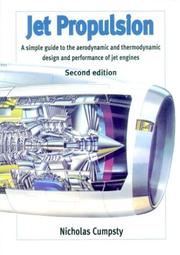 Jet PropulsionNicholas Cumpsty · 2003
 JetSir Frank Whittle · 1953
 Physics of electric propulsionRobert G. Jahn · 1968
 Rise of the Rocket GirlsNathalia Holt, Nathalia Holt · 2016
- 📕Aerospace PropulsionT. W. Lee · 2013
Ranked by number of editions on Open Library, a rough measure of how lasting a book is.
🔗 Related topics
- Flight Flight or flying is the motion of an object through an atmosphere or through the vacuum of space, in this case also called spaceflight, without contacting…
- Thrust Thrust is a reaction force described quantitatively by Newton's third law. When a system expels or accelerates mass in one direction, the accelerated mass…
- Distributed propulsion In aeronautics, distributed propulsion is an arrangement in which the propulsive units and related air flows are distributed over the aerodynamic surfaces…
- Mass driver A mass driver or electromagnetic catapult is a proposed method of non-rocket spacelaunch which would use a linear motor to accelerate and catapult payloads…
- Spacecraft propulsion Spacecraft propulsion is any method used to change the velocity of spacecraft or artificial satellites. In-space propulsion is used to maneuver the spacecraft…
- Vehicle A vehicle (from Latin vehiculum) is a machine designed for self-propulsion, usually to transport people, cargo, or both. The term "vehicle" typically refers…
- Reaction engine A reaction engine is an engine or motor that produces thrust by expelling reaction mass (reaction propulsion), in accordance with Newton's third law of…
- Rocket A rocket (from Italian: rocchetto, lit. ''bobbin/spool'', and so named for its shape) is an elongated flying vehicle that uses a rocket engine to accelerate…