Everything about Non-coding DNA
DNA that does not code for proteins

Non-coding DNA (ncDNA) sequences are components of an organism's DNA that do not encode protein sequences. Some non-coding DNA is transcribed into functional non-coding RNA molecules. Other functional regions of the non-coding DNA fraction include regulatory sequences that control gene expression; scaffold attachment regions; origins of DNA replication; centromeres; and telomeres. Some non-coding regions appear to be mostly nonfunctional, such as introns, pseudogenes, intergenic DNA, and fragments of transposons and viruses. Regions that are completely nonfunctional are called junk DNA. Wikipedia →
🧭 Start here: a 6-step reading path
- Read the overview: Non-coding DNAA 5-minute orientation
- Skim a recent paper: Secure DNA-Coding Image Optical Communication Using Non-Degenerate Hyperchaos and Dynamic Secret-KeyInfluential work since 2022
- Pick up a classic book: The common threadThe most-reprinted book on the subject
- Read the landmark paper: The relationship between non‐protein‐coding DNA and eukaryotic complexityCited 555 times
- Go sideways: Intergenic regionA closely related topic
- Go sideways: G-value paradoxA closely related topic
📖 Definitions
No dictionary entry for this exact phrase.
🏆 Landmark papers (most cited)
The relationship between non‐protein‐coding DNA and eukaryotic complexity
Adaptive evolution of non-coding DNA in Drosophila
Phylogenetics of asterids based on 3 coding and 3 non-coding chloroplast DNA markers and the utility of non-coding DNA at higher taxonomic levels
Non-coding RNA directed DNA demethylation of Sphk1 CpG island
Predicting the impact of non-coding variants on DNA methylation
Non-coding RNAs: An emerging player in DNA damage response
Non‐coding RNAs in DNA damage and repair
Non-coding nuclear DNA markers in phylogenetic reconstruction
🆕 Influential since 2022
Secure DNA-Coding Image Optical Communication Using Non-Degenerate Hyperchaos and Dynamic Secret-Key
A non-coding RNA balancing act: miR-346-induced DNA damage is limited by the long non-coding RNA NORAD in prostate cancer
Biomarkers of Bladder Cancer: Cell-Free DNA, Epigenetic Modifications and Non-Coding RNAs
DNA and coding/non‐coding RNA methylation analysis provide insights into tomato fruit ripening
DNA Methylation and Non-Coding RNAs during Tissue-Injury Associated Pain
📚 Books worth reading
 The common threadJohn Sulston, Georgina Ferry · 2002
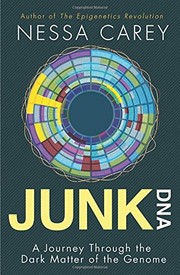 Junk DNANessa Carey · 2015
 Genomics protocols · 2001
Ranked by number of editions on Open Library, a rough measure of how lasting a book is.
🔗 Related topics
- Intergenic region An intergenic region is a stretch of DNA sequences located between genes. Intergenic regions may contain functional elements and junk DNA. Intergenic regions…
- G-value paradox The G-value paradox arises from the lack of correlation between the number of protein-coding genes among eukaryotes and their relative biological complexity…
- Gene In biology, the word gene has two meanings. The Mendelian gene is a basic unit of heredity. The molecular gene is a sequence of nucleotides in DNA that…
- Junk DNA Junk DNA (non-functional DNA) is a DNA sequence that has no known biological function. Most organisms have some junk DNA in their genomes—mostly pseudogenes…
- Pseudogene Pseudogenes are nonfunctional segments of DNA that resemble functional genes. Pseudogenes can be formed from both protein-coding genes and non-coding genes…
- Short interspersed nuclear element Short interspersed nuclear elements (SINEs) are non-autonomous, non-coding transposable elements (TEs) that are about 100 to 700 base pairs in length.…
- Intron An intron is any nucleotide sequence within a gene that is not expressed or operative in the final RNA product. The word intron is derived from the term…
- Conserved non-coding sequence A conserved non-coding sequence (CNS) is a DNA sequence of noncoding DNA that is evolutionarily conserved. Sequence conservation is a useful marker of…