Everything about Formal fallacy
Faulty deductive reasoning due to a logical flaw
In logic and philosophy, a formal fallacy is a pattern of reasoning with a flaw in its logical structure. A formal fallacy is contrasted with an informal fallacy. A formal fallacy must have an invalid logical form and thus be unsound. An informal fallacy, however, may have a valid logical form and yet be unsound because one or more premises are false. An argument can be both a formal fallacy and an informal fallacy. In everyday conversation, the term logical fallacy usually refers to a formal fallacy. Wikipedia →
🧭 Start here: a 6-step reading path
- Read the overview: Formal fallacyA 5-minute orientation
- Skim a recent paper: The plat-formalisation fallacyInfluential work since 2022
- Pick up a classic book: Philosophy -- A Text with ReadingsThe most-reprinted book on the subject
- Read the landmark paper: Suppressing natural heuristics by formal instruction: The case of the conjunction fallacyCited 60 times
- Go sideways: Logical reasoningA closely related topic
- Go sideways: Deductive reasoningA closely related topic
📖 Definitions
Noun A pattern of reasoning which is always wrong, due to a flaw in the structure of the argument.
🗂️ The subject at a glance
🏆 Landmark papers (most cited)
Suppressing natural heuristics by formal instruction: The case of the conjunction fallacy
Fallacy of formal discourse analysis
The Formal Fallacy of the Cosmological Argument
Comment: Formal operations and the fallacy of asserting the consequent
Is there a modal fallacy in van Inwagen's 'First Formal Argument'?
Marvell’s Formal Fallacy
Is False Dilemma Really a Formal Fallacy?
Formal Dialectic in Fallacy Inquiry: An Unintelligible Circumscription of Argumentative Rationality?
🆕 Influential since 2022
📚 Books worth reading
 Philosophy -- A Text with ReadingsManuel G. Velasquez, Vincent E. Barry · 1980
 Writing ArgumentsJohn D. Ramage, John C. Bean · 2000
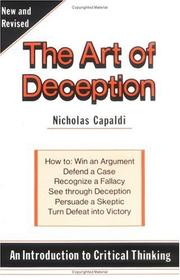 The art of deceptionNicholas Capaldi · 1971
 The origin of ideasAntonio Rosmini · 1883
 Winning on appealRuggero J. Aldisert · 1992
 Houghton Mifflin college reading seriesHoughton Mifflin Company, Hmco · 2004
 Making better decisionsItzhak Gilboa · 2010
 Phonology and language useJoan Bybee · 2001
Ranked by number of editions on Open Library, a rough measure of how lasting a book is.
🔗 Related topics
- Logical reasoning Logical reasoning is a form of thinking or information processing that aims to arrive at a conclusion in a rigorous way. It happens in the form of inferences…
- Deductive reasoning Deductive reasoning is the process of drawing valid inferences. An inference is valid if its conclusion follows logically from its premises, meaning that…
- Argument An argument is one or more premises—sentences, statements, or propositions—directed towards arriving at a logical conclusion. The purpose of an argument…
- Fallacy A fallacy is the use of invalid or otherwise faulty reasoning in the construction of an argument that may appear to be well-reasoned if unnoticed. The…
- Logic Logic is the study of correct reasoning. It includes both formal and informal logic. Formal logic is the study of deductively valid inferences or logical…
- Rule of inference Rules of inference are ways of deriving conclusions from premises. They are integral parts of formal logic, serving as the logical structure of valid arguments…
- Philosophy of logic Philosophy of logic is the branch of philosophy that studies the scope and nature of logic. It investigates the philosophical problems raised by logic…
- Premise A premise is a proposition offered to support a conclusion. Premises are true or false statements that act as the starting points of arguments by presenting…