Live briefing

Everything about Second language
Language spoken in addition to one's first language
A second language (L2) is a language spoken in addition to one's first language (L1). A second language may be a neighbouring language, another language of the speaker's home country, or a foreign language. Wikipedia →
🧭 Start here: a 6-step reading path
- Read the overview: Second languageA 5-minute orientation
- Skim a recent paper: Using ChatGPT for second language writing: Pitfalls and potentialsInfluential work since 2022
- Pick up a classic book: Strangers On a TrainThe most-reprinted book on the subject
- Read the landmark paper: Partial Least Squares Structural Equation Modeling (PLS-SEM) in second language and education research: Guidelines using an applied exampleCited 2,723 times
- Go sideways: Second-language acquisitionA closely related topic
- Go sideways: Theories of second-language acquisitionA closely related topic
📖 Definitions
Noun A language that is spoken by someone but is not their mother tongue.
🗂️ The subject at a glance
🏆 Landmark papers (most cited)
Partial Least Squares Structural Equation Modeling (PLS-SEM) in second language and education research: Guidelines using an applied example
Long-term relationships among early first language skills, second language aptitude, second language affect, and later second language proficiency
Second language writing as and for second language learning
Second Language Autonomy
Subcomponents of Second-Language Aptitude and Second-Language Proficiency
Is Second Language Attrition the Reversal of Second Language Acquisition?
The relation of second language acquisition, instructed second language acquisition, and language teaching from the lens of second language tense-aspect
Spoken second language words activate native language orthographic information in late second language learners
🆕 Influential since 2022
📚 Books worth reading
 Strangers On a TrainPatricia Highsmith · 1950
 The new Cambridge English courseMichael Swan, Michael Swan · 1990
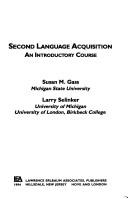 Second language acquisitionSusan M. Gass, Larry Selinker · 1994
 Expressways 3 Test PackageSteven J. Molinsky · 1986
 A guide to reading & writing Japanese坂出 フローレンス · 1959
 Second language learning theoriesRosamond Mitchell, Florence Myles · 1998
 Oxford Picture DictionaryNorma Shapiro, Jayme Adelson-Goldstein · 1999
 Second language researchAlison Mackey · 2005
Ranked by number of editions on Open Library, a rough measure of how lasting a book is.
🔗 Related topics
- Second-language acquisition Second-language acquisition (SLA), second-language learning or L2 (language 2) acquisition, is the process of learning a language other than one's native…
- Theories of second-language acquisition The main purpose of theories of second-language acquisition (SLA) is to shed light on how people who already know one language learn a second language…
- Input hypothesis The input hypothesis, also known as the monitor model, is a group of five hypotheses of second-language acquisition developed by the linguist Stephen Krashen…
- Critical period hypothesis The critical period hypothesis is a hypothesis within the field of linguistics and second language acquisition that claims a person can achieve native-like…
- Generative second-language acquisition The generative approach to second language (L2) acquisition (SLA) is a cognitive based theory of SLA that applies theoretical insights developed from within…
- Sequential bilingualism Sequential bilingualism occurs when a person becomes bilingual by first learning one language and then another. The process is contrasted with simultaneous…
- Multi-competence Multi-competence is a concept in second language acquisition formulated by Vivian Cook that refers to the knowledge of more than one language in one person's…
- Interlanguage An interlanguage is an idiolect developed by a learner of a second language (L2) which preserves some features of their first language (L1) and can overgenerali…