Live briefing

Everything about SPARQL
RDF query language
SPARQL is an RDF query language—that is, a semantic query language for databases—able to retrieve and manipulate data stored in Resource Description Framework (RDF) format. It was made a standard by the RDF Data Access Working Group (DAWG) of the World Wide Web Consortium, and is recognized as one of the key technologies of the semantic web. On 15 January 2008, SPARQL 1.0 was acknowledged by W3C as an official recommendation, and SPARQL 1.1 in March, 2013. Wikipedia →
🧭 Start here: a 6-step reading path
- Read the overview: SPARQLA 5-minute orientation
- Skim a recent paper: SGPT: A Generative Approach for SPARQL Query Generation From Natural Language QuestionsInfluential work since 2022
- Pick up a classic book: Learning SPARQLThe most-reprinted book on the subject
- Read the landmark paper: Semantics and complexity of SPARQLCited 765 times
- Go sideways: RDF SchemaA closely related topic
- Go sideways: Resource Description FrameworkA closely related topic
📖 Definitions
No dictionary entry for this exact phrase.
🗂️ The subject at a glance
🏆 Landmark papers (most cited)
Semantics and complexity of SPARQL
The Berlin SPARQL Benchmark
Ontop: Answering SPARQL queries over relational databases
Scalable SPARQL querying of large RDF graphs
C-SPARQL: A CONTINUOUS QUERY LANGUAGE FOR RDF DATA STREAMS
gStore: a graph-based SPARQL query engine
Querying RDF streams with C-SPARQL
Extending SPARQL with regular expression patterns (for querying RDF)
🆕 Influential since 2022
SGPT: A Generative Approach for SPARQL Query Generation From Natural Language Questions
LLM4QA: Leveraging Large Language Model for Efficient Knowledge Graph Reasoning with SPARQL Query
IndeGx: A model and a framework for indexing RDF knowledge graphs with SPARQL-based test suits
Chrontext: Portable SPARQL queries over contextualised time series data in industrial settings
SPARQL-QA-v2 system for Knowledge Base Question Answering
📚 Books worth reading
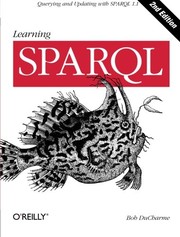 Learning SPARQLBob DuCharme · 2011
 Normdaten in WikidataJakob Voß · 2014
 Web reasoning and rule systemsRR 2010 (2010 Bressanone/Brixen, Italy) · 2010
Ranked by number of editions on Open Library, a rough measure of how lasting a book is.
🔗 Related topics
- RDF Schema RDF Schema (Resource Description Framework Schema, variously abbreviated as RDFS, RDF(S), RDF-S, or RDF/S) is a set of classes with certain properties…
- Resource Description Framework The Resource Description Framework (RDF) is a method to describe and exchange graph data. It was originally designed as a data model for metadata by the…
- Named graph Named graphs are a key concept of Semantic Web architecture in which a set of Resource Description Framework statements (a graph) are identified using…
- Turtle (syntax) In computing, Terse RDF Triple Language (Turtle) is a syntax and file format for expressing data in the Resource Description Framework (RDF) data model…
- N-Triples N-Triples is a format for storing and transmitting data. It is a line-based, plain text serialisation format for RDF (Resource Description Framework) graphs…
- RDF query language An RDF query language is a computer language, specifically a query language for databases, able to retrieve and manipulate data stored in Resource Description…
- RDFa RDFa or Resource Description Framework in Attributes is a W3C Recommendation that adds a set of attribute-level extensions to HTML, XHTML and various XML-based…
- Semantic Web The Semantic Web, sometimes known as Web 3.0, is an extension of the World Wide Web through standards set by the World Wide Web Consortium (W3C). The goal…