Live briefing
Everything about Quantum error correction
Process in quantum computing
Quantum error correction (QEC) comprises a set of techniques used in quantum memory and quantum computing to protect quantum information from errors arising from decoherence and other sources of quantum noise. QEC schemes that employ codewords stabilized by a set of commuting operators are known as stabilizer codes, and the corresponding codewords are referred to as quantum error-correcting codes (QECCs). Wikipedia →
🧭 Start here: a 6-step reading path
- Read the overview: Quantum error correctionA 5-minute orientation
- Skim a recent paper: Quantum error correction below the surface code thresholdInfluential work since 2022
- Pick up a classic book: Quantum Error Correction and Fault Tolerant Quantum ComputingThe most-reprinted book on the subject
- Read the landmark paper: Quantum error correction for quantum memoriesCited 1,230 times
- Go sideways: Eastin–Knill theoremA closely related topic
- Go sideways: Physical and logical qubitsA closely related topic
📖 Definitions
No dictionary entry for this exact phrase.
🏆 Landmark papers (most cited)
Quantum error correction for quantum memories
Quantum error correction for beginners
Experimental Quantum Error Correction
Realization of quantum error correction
Quantum error correction: an introductory guide
Experimental Repetitive Quantum Error Correction
Improved Quantum Metrology Using Quantum Error Correction
Quantum Error Correction for Metrology
🆕 Influential since 2022
📚 Books worth reading
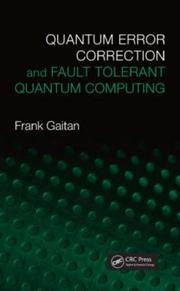 Quantum Error Correction and Fault Tolerant Quantum ComputingFrank Gaitan · 2008
 Quantum Error CorrectionDaniel A. Lidar, Todd A. Brun · 2013
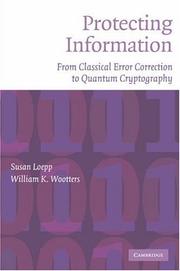 Protecting InformationSusan Loepp, William Wootters · 2006
- 📕Quantum Error Correction and Fault Tolerant Quantum Computing - SGaitan Frank Staff · 2007
- 📕Lectures on quantum computation, quantum errorK. R. Parthasarathy · 2006
 The complexity of noiseAmit Hagar · 2010
- 📕Liang zi jiu cuo maKeqin Feng · 2010
Ranked by number of editions on Open Library, a rough measure of how lasting a book is.
🔗 Related topics
- Eastin–Knill theorem The Eastin–Knill theorem is a no-go theorem that states: "No quantum error correcting code can have a continuous symmetry which acts transversely on physical…
- Physical and logical qubits In quantum computing, a qubit is a unit of information analogous to a bit (binary digit) in classical computing, but it is affected by quantum mechanical…
- Cat state In quantum mechanics, the cat state, named after Schrödinger's cat, refers to a quantum state. Generalizing Erwin Schrödinger's thought experiment, a cat…
- Bacon–Shor code The Bacon–Shor code is a subsystem error correcting code. In a subsystem code, information is encoded in a subsystem of a Hilbert space. Subsystem codes…
- Stabilizer code In quantum computing and quantum communication, a stabilizer code is a class of quantum codes for performing quantum error correction. The toric code,…
- Five-qubit error correcting code The five-qubit error correcting code, [[5,1,3]] code, or Laflamme–Miquel–Paz–Zurek code is the smallest quantum error correcting code that can protect…
- Surface code The surface code is a topological quantum error correcting code, and an example of a stabilizer code, defined on a two-dimensional spin lattice. The first…
- Glossary of quantum computing This glossary of quantum computing is a list of definitions of terms and concepts used in quantum computing, its sub-disciplines, and related fields. Bacon–Shor…