Everything about Delta modulation
Signal conversion technique

Delta modulation is an analog-to-digital and digital-to-analog signal conversion technique used for transmission of voice information where quality is not of primary importance. DM is the simplest form of differential pulse-code modulation (DPCM) where the difference between successive samples is encoded into n-bit data streams. In delta modulation, the transmitted data are reduced to a 1-bit data stream representing either up (↗) or down (↘). Its main features are:The analog signal is approximated with a series of segments. Each segment of the approximated signal is compared to the preceding bits and the successive bits are determined by this comparison. Only the change of information is sent, that is, only an increase or decrease of the signal amplitude from the previous sample is sent whereas a no-change condition causes the modulated signal to remain at the same ↗ or ↘ state of the previous sample. Wikipedia →
🧭 Start here: a 6-step reading path
- Read the overview: Delta modulationA 5-minute orientation
- Skim a recent paper: Endogenous modulation of delta phase by expectation–A replication of Stefanics et al., 2010Influential work since 2022
- Pick up a classic book: Circuits and Systems Based on Delta ModulationThe most-reprinted book on the subject
- Read the landmark paper: Oversampled Sigma-Delta ModulationCited 287 times
- Go sideways: Delta-sigma modulationA closely related topic
- Go sideways: Pulse-code modulationA closely related topic
📖 Definitions
No dictionary entry for this exact phrase.
🏆 Landmark papers (most cited)
Oversampled Sigma-Delta Modulation
Decimation for Sigma Delta Modulation
Bandpass sigma-delta modulation
Linear and adaptive delta modulation
Multistage sigma-delta modulation
Asynchronous delta-modulation system
Spur-Free MASH Delta-Sigma Modulation
On Delta Modulation
🆕 Influential since 2022
Endogenous modulation of delta phase by expectation–A replication of Stefanics et al., 2010
Demonstration of 4096QAM THz MIMO wireless delivery employing one-bit delta-sigma modulation
Delta-doping modulation of three quantum wells under the influence of an electric field
SNR enhanced OAM mode division multiplexing with in-band noise modulation based on cascade delta-sigma modulation
NTF-Improved Delta-Sigma Modulation Supported 65536 QAM Signal for Mobile Fronthaul
📚 Books worth reading
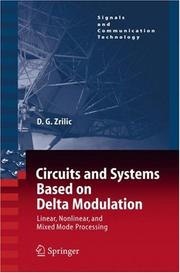 Circuits and Systems Based on Delta ModulationDjuro G. Zrilic · 2005
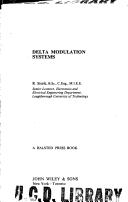 Delta modulation systemsRaymond Steele · 1975
- 📕High-accuracy circuits for on-chip capacitor ratio testing and sensor readoutBo Wang · 1998
- 📕A delta-sigma pulse width modulator with pulse ditheringRichard S. Lewison · 1997
- 📕Lo stato presente della modulazione a delta per la trasmissione della voceMaurizio Federici · 1969
- 📕Experimental verification of a mismatch-shaping DACWilliam Forrest Hudson · 1997
- 📕Compensation techniques for cascaded delta-sigma A/D converters and high-performance switched-capacitor circuitsTao Sun · 1998
- 📕Intelligibility of delta modulated telephone signalsFranco Bertora · 1969
Ranked by number of editions on Open Library, a rough measure of how lasting a book is.
🔗 Related topics
- Delta-sigma modulation Delta–sigma (ΔΣ; or sigma–delta, ΣΔ) modulation is an oversampling method for encoding signals into low bit depth digital signals at a very high sample-frequenc…
- Pulse-code modulation Pulse-code modulation (PCM) is a method used to digitally represent analog signals. It is the standard form of digital audio in computers, compact discs…
- Signal modulation Signal modulation is the process of varying one or more properties of a periodic waveform in electronics and telecommunication for the purpose of transmitting…
- Pulse-density modulation Pulse-density modulation (PDM) is a form of modulation used to represent an analog signal with a binary signal. In a PDM signal, specific amplitude values…
- Continuously variable slope delta modulation Continuously variable slope delta modulation (CVSD or CVSDM) is a voice coding method. It is a delta modulation with variable step size (i.e., special…
- Analog-to-digital converter In electronics, an analog-to-digital converter (ADC, A/D, or A-to-D) is a system that converts an analog signal, such as from fingers touching a touchscreen…
- Sub-band coding In signal processing, sub-band coding (SBC) is any form of transform coding that breaks a signal into a number of different frequency bands, typically…
- Adaptive differential pulse-code modulation Adaptive differential pulse-code modulation (ADPCM) is a variant of differential pulse-code modulation (DPCM) that varies the size of the quantization…