Live briefing
Everything about Counterfactual conditional
Conditionals that discuss what would have been if things were otherwise
Counterfactual conditionals are conditional sentences that describe what would have been true if circumstances had been different, typically when the antecedent is taken to be false or incompatible with what actually happened. In English they are often formed with a past or irrealis morphology, as in "If Peter believed in ghosts, he would be afraid to be here", and are standardly contrasted with indicative conditionals, which are generally used to discuss live or open possibilities. Wikipedia →
🧭 Start here: a 6-step reading path
- Read the overview: Counterfactual conditionalA 5-minute orientation
- Skim a recent paper: The influence of temporal information on online processing of counterfactual conditional sentences: Evidence from ERPs on temporal indicatorsInfluential work since 2022
- Pick up a classic book: Shakespeare in HindsightThe most-reprinted book on the subject
- Read the landmark paper: The Conditional Sink: Counterfactual Display in the Valuation of a Carbon Offsetting Reforestation ProjectCited 50 times
- Go sideways: Conditional sentenceA closely related topic
- Go sideways: English conditional sentencesA closely related topic
📖 Definitions
Noun (linguistics) A "what if" statement.
🗂️ The subject at a glance
🏆 Landmark papers (most cited)
The Conditional Sink: Counterfactual Display in the Valuation of a Carbon Offsetting Reforestation Project
The effects of output task types on noticing and learning of the English past counterfactual conditional
Basic Conditional Reasoning: How Children Mimic Counterfactual Reasoning
Conditional Reasoning and Emotional Experience: A Review of the Development of Counterfactual Thinking
The effect of causal chain length on counterfactual conditional reasoning
Children’s reasoning about other’s intentions: False-belief and counterfactual conditional inferences
First-time, first-repeat and multiple-repeat visitors: a conditional counterfactual quantile expenditure decomposition analysis
Counterfactuals vs. conditional probabilities: A critical analysis of the counterfactual theory of information
🆕 Influential since 2022
The influence of temporal information on online processing of counterfactual conditional sentences: Evidence from ERPs on temporal indicators
Temporal Shift Length and Antecedent Occurrence Likelihood Modulate Counterfactual Conditional Comprehension: Evidence from Event-Related Potentials
Sequential Conditional Transport on Probabilistic Graphs for Interpretable Counterfactual Fairness
Sparse Identification of Conditional relationships in Structural Causal Models (SICrSCM) for counterfactual inference
CACE: A Framework for Generating Counterfactual Explanations Aligned With Causal Structure via Jointly Learned Conditional Distributions
📚 Books worth reading
- 📕Shakespeare in HindsightAmir Khan · 2015
 CounterfactualsLewis, David K. · 1973
 Pacific War and Contingent VictoryMichael Myers · 2015
- 📕Fei jing dian luo ji xi tong fa sheng xue yan jiuXiaoming Ren · 2011
- 📕A history of English counterfactualsRafał Molencki · 1999
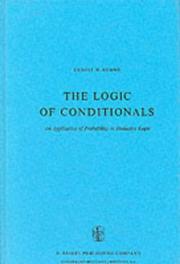 The logic of conditionalsErnest W. Adams · 1975
 Subjunctive reasoningJohn L. Pollock · 1976
- 📕Irrealis und KonditionallogikWolfgang Waletzki · 1997
Ranked by number of editions on Open Library, a rough measure of how lasting a book is.
🔗 Related topics
- Conditional sentence A conditional sentence is a sentence in a natural language that expresses that one thing is contingent on another, e.g., "If it rains, the picnic will…
- English conditional sentences Prototypical conditional sentences in English are those of the form "If X, then Y". The clause X is referred to as the antecedent (or protasis), while…
- Indicative conditional An indicative conditional is a natural-language conditional sentence (an "if" sentence) used to talk about what may actually be the case, as in: "If Leona…
- Paradoxes of material implication The paradoxes of material implication are a group of classically true formulae involving material conditionals whose translations into natural language…
- Strict conditional In logic, a strict conditional (symbol: ◻ {\displaystyle \Box } , or ⥽) is a conditional governed by a modal operator, that is, a logical connective of…
- Grammatical mood In linguistics, grammatical mood is a grammatical feature of verbs, used for signaling modality. In other words, it is the use of verbal inflections that…
- Conditional logic Conditional logic (also: the logic of conditionals) refers to a family of formal systems for reasoning with statements of the form "if A, (then) B". Conditional…
- English subjunctive While the English language lacks distinct inflections for mood, an English subjunctive is recognized in most grammars. Definition and scope of the concept…