Live briefing

Everything about Color appearance model
Any mathematical model describing human perception of colors
A color appearance model (CAM) is a mathematical model that seeks to describe the perceptual aspects of human color vision, i.e. viewing conditions under which the appearance of a color does not tally with the corresponding physical measurement of the stimulus source. Wikipedia →
🧭 Start here: a 6-step reading path
- Read the overview: Color appearance modelA 5-minute orientation
- Skim a recent paper: Simple color appearance model (sCAM) based on simple uniform color space (sUCS)Influential work since 2022
- Pick up a classic book: The Art of Public SpeakingThe most-reprinted book on the subject
- Read the landmark paper: Color‐appearance model and chromatic‐adaptation transformCited 73 times
- Go sideways: CIECAM02A closely related topic
- Go sideways: CIELAB color spaceA closely related topic
📖 Definitions
No dictionary entry for this exact phrase.
🗂️ The subject at a glance
🏆 Landmark papers (most cited)
Color‐appearance model and chromatic‐adaptation transform
A nonlinear color‐appearance model using estévez‐hunt‐pointer primaries
Meet iCAM: A Next-Generation Color Appearance Model
Influence of Natural Daylight on Soil Color Description: Assessment Using a Color-Appearance Model
A practical appearance model for dynamic facial color
A Color Appearance Model Applicable in Mesopic Vision
Color-appearance-model based fusion of gray and pseudo-color images for medical applications
Color appearance model for self-luminous stimuli
🆕 Influential since 2022
Simple color appearance model (sCAM) based on simple uniform color space (sUCS)
Collisional radiative model based investigation on the color appearance of xenon plasma in Hall thruster plumes
A Physiologically‐Based Simulation Model of Color Appearance for Red‐Green Color Vision Deficiency
Color appearance models CAM16, ZCAM and CAM20u for video applications
SiCAM: Spectral image Color Appearance Model
📚 Books worth reading
 The Art of Public SpeakingStephen E. Lucas · 1983
 Intelligence BulletinUnited States. War Department. Military Intelligence Service · 1942
 Ten epochs of church historyFulton, John, 1834-1907, Locke, Clinton, 1829-1904 · 1879
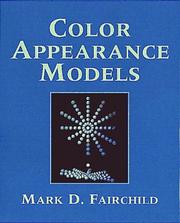 Color appearance modelsMark D. Fairchild · 1998
 The history of Detroit and MichiganSilas Farmer · 1884
 Treaty Occupationay ToxicologySuelen Queiroz · 2010
 The Conspirators HierarchyJohn Coleman · 1992
 R Graphics CookbookWinston Chang · 2012
Ranked by number of editions on Open Library, a rough measure of how lasting a book is.
🔗 Related topics
- CIECAM02 In colorimetry, CIECAM02 is the color appearance model published in 2002 by the International Commission on Illumination (CIE) Technical Committee 8-01…
- CIELAB color space The CIELAB color space, also referred to as L*a*b*, is a color space defined by the International Commission on Illumination (abbreviated CIE) in 1976…
- Chromaticity Chromaticity is an objective specification of the quality of a color regardless of its luminance. Chromaticity consists of two independent parameters,…
- List of color spaces and their uses This is a list of color spaces, grouped by the color model that is used for part of their specification. Color models can be based on physics or human…
- CIELUV In colorimetry, the CIE 1976 L*, u*, v* color space, commonly known by its abbreviation CIELUV, is a color space adopted by the International Commission…
- Colorfulness Colorfulness, chroma and saturation are attributes of perceived color relating to chromatic intensity. As defined formally by the International Commission…
- Lightness Lightness is a visual perception of the luminance ( L ) {\displaystyle (L)} of an object. It is often judged relative to a similarly lit object. In colorimetry…
- CIE 1931 color space In 1931, the International Commission on Illumination (CIE) published the CIE 1931 color spaces which define the relationship between the visible spectrum…