Everything about Wetware computer
Computer composed of organic material

A wetware computer is an organic computer composed of organic material "wetware" such as "living" neurons. Wetware computers composed of neurons are different than conventional computers because they use biological materials, and offer the possibility of substantially more energy-efficient computing. While a wetware computer is still largely conceptual, there has been limited success with construction and prototyping, which has acted as a proof of the concept's realistic application to computing in the future. The most notable prototypes have stemmed from the research completed by biological engineer William Ditto during his time at the Georgia Institute of Technology. His work constructing a simple neurocomputer capable of basic addition from leech neurons in 1999 was a significant discovery for the concept. This research was a primary example driving interest in creating these artificially constructed, but still organic brains. Wikipedia →
🧭 Start here: a 6-step reading path
- Read the overview: Wetware computerA 5-minute orientation
- Pick up a classic book: WetwareThe most-reprinted book on the subject
- Read the landmark paper: Open and remotely accessible Neuroplatform for research in wetware computingCited 47 times
- Go sideways: Neuromorphic computingA closely related topic
- Go sideways: Organoid intelligenceA closely related topic
📖 Definitions
No dictionary entry for this exact phrase.
🏆 Landmark papers (most cited)
Open and remotely accessible Neuroplatform for research in wetware computing
Molecular Computation and Evolutionary Wetware: A Cutting-Edge Technology for Artificial Life and Nanobiotechnologies
Advanced Brain‐on‐a‐Chip for Wetware Computing: A Review
What Is It Like to Be a Cell? Wetware A Computer in Every Living Cell by Dennis Bray Yale University Press, New Haven, CT, 2009. 279 pp. $28, £18.99. ISBN 9780300141733.
Wetware: a computer in every living cell
Genes & cells: Computer chips wired with wetware: Experiments could lead to ways of melding mind and machine
Wetware: A Computer in Every Living Cell. Dennis Bray. (2009, New Haven, London: Yale University Press.) $28 (hardback), 267 pages.
📚 Books worth reading
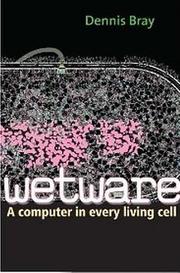 WetwareDennis Bray · 2009
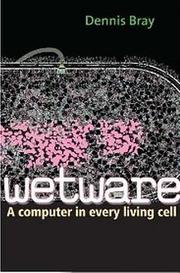 WetwareDennis Bray · 2009
 Shortest Path Solvers. From Software to WetwareAndrew Adamatzky · 2018
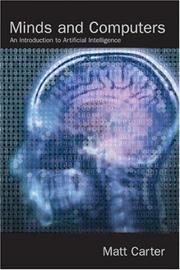 Minds and ComputersMatt Carter · 2007
 Unconventional Computing 2005 · 2005
 Natural and Artificial Models in Computation and BiologyJosé Manuel Ferrández Vicente · 2013
 Only humans need applyDavenport, Thomas H. · 2016
- 📕Castor&&Pollux · 2019
Ranked by number of editions on Open Library, a rough measure of how lasting a book is.
🔗 Related topics
- Neuromorphic computing Neuromorphic computing is a computing approach inspired by the human brain's structure and function. It uses artificial neurons to perform computations…
- Organoid intelligence Organoid intelligence (OI) is an emerging field of study in computer science and biology that develops and studies biological wetware computing using 3D…
- Bio-inspired computing Bio-inspired computing, short for biologically inspired computing, is a field of study which seeks to solve computer science problems using models of biology…
- Hybrot A hybrot (short for "hybrid robot") is a cybernetic organism in the form of a robot controlled by a computer consisting of both electronic and biological…
- Cortical Labs Cortical Labs is an Australian biological computing company (also referred to as "wetware") founded in 2019 by Hon Weng Chong, and Andy Kitchen based in…
- Artificial neuron An artificial neuron is a mathematical function conceived as a model of a biological neuron in a neural network. The artificial neuron is the elementary…
- Cognitive computer A cognitive computer is a computer that hardwires artificial intelligence and machine learning algorithms into an integrated circuit that closely reproduces…
- Spiking neural network Spiking neural networks (SNNs) are artificial neural networks (ANN) that mimic natural neural networks. These models leverage timing of discrete spikes…