Live briefing
Everything about Cognitive computer
Machine designed to mimic the human brain
A cognitive computer is a computer that hardwires artificial intelligence and machine learning algorithms into an integrated circuit that closely reproduces the behavior of the human brain. It generally adopts a neuromorphic engineering approach. Synonyms include neuromorphic chip and cognitive chip. Wikipedia →
🧭 Start here: a 6-step reading path
- Read the overview: Cognitive computerA 5-minute orientation
- Skim a recent paper: Human emotion recognition from EEG-based brain–computer interface using machine learning: a comprehensive reviewInfluential work since 2022
- Pick up a classic book: I, RobotThe most-reprinted book on the subject
- Read the landmark paper: Computer-based Cognitive Training for Mild Cognitive ImpairmentCited 250 times
- Go sideways: SyNAPSEA closely related topic
- Go sideways: Neuromorphic computingA closely related topic
📖 Definitions
No dictionary entry for this exact phrase.
🗂️ The subject at a glance
🏆 Landmark papers (most cited)
Computer-based Cognitive Training for Mild Cognitive Impairment
Computer-administered cognitive-behavioral therapy for depression
Computer-Based, Personalized Cognitive Training versus Classical Computer Games: A Randomized Double-Blind Prospective Trial of Cognitive Stimulation
Computer Assessment of Mild Cognitive Impairment
Brain–computer interfacing based on cognitive control
Cognitive factors in computer anxiety
Computer-based Cognitive Training for ADHD
Cognitive Effects With and Of Computer Technology
🆕 Influential since 2022
Human emotion recognition from EEG-based brain–computer interface using machine learning: a comprehensive review
A Survey on Measuring Cognitive Workload in Human-Computer Interaction
Improving Computer-Assisted Language Learning Through the Lens of Cognitive Load
Emotional and cognitive effects of learning with computer simulations and computer videogames
Poststroke Cognitive Impairment Research Progress on Application of Brain‐Computer Interface
📚 Books worth reading
 I, RobotIsaac Asimov · 1950
 ComputerdenkenRoger Penrose · 1989
 The Psychology of Everyday ThingsDonald A. Norman · 1988
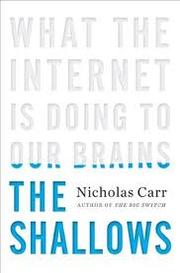 The ShallowsNicholas G. Carr · 2010
 Artificial general intelligenceBen Goertzel, Cassio Pennachin · 2007
 Introduction to Neural and Cognitive ModelingDaniel S. Levine · 1991
 SuperintelligenceNick Bostrom · 2014
 Inferred functions of performance and learningSiegfried Engelmann, Donald Steely · 2003
Ranked by number of editions on Open Library, a rough measure of how lasting a book is.
🔗 Related topics
- SyNAPSE SyNAPSE is a DARPA program that aims to develop electronic neuromorphic machine technology, an attempt to build a new kind of cognitive computer with form…
- Neuromorphic computing Neuromorphic computing is a computing approach inspired by the human brain's structure and function. It uses artificial neurons to perform computations…
- Dharmendra Modha Dharmendra S. Modha is an Indian American manager and lead researcher of the Cognitive Computing group at IBM Almaden Research Center. He is known for…
- Bio-inspired computing Bio-inspired computing, short for biologically inspired computing, is a field of study which seeks to solve computer science problems using models of biology…
- SpiNNaker SpiNNaker (spiking neural network architecture) is a massively parallel, manycore supercomputer architecture designed by the Advanced Processor Technologies…
- Spiking neural network Spiking neural networks (SNNs) are artificial neural networks (ANN) that mimic natural neural networks. These models leverage timing of discrete spikes…
- Wetware computer A wetware computer is an organic computer (which can also be known as an artificial organic brain or a neurocomputer) composed of organic material "wetware"…
- Brain simulation In the field of computational neuroscience, brain simulation is the concept of creating a functioning computer model of a brain or part of a brain. Brain…