Live briefing

Everything about Visual acuity
Clarity of vision
Visual acuity (VA) commonly refers to the clarity of vision, but technically rates an animal's ability to recognize small details with precision. Visual acuity depends on optical and neural factors. Optical factors of the eye influence the sharpness of an image on its retina. Neural factors include the health and functioning of the retina, of the neural pathways to the brain, and of the interpretative faculty of the brain. Wikipedia →
🧭 Start here: a 6-step reading path
- Read the overview: Visual acuityA 5-minute orientation
- Skim a recent paper: Eye drift during fixation predicts visual acuityInfluential work since 2022
- Pick up a classic book: Psychophysics of Reading in Normal and Low VisionThe most-reprinted book on the subject
- Read the landmark paper: Visual AcuityCited 60 times
- Go sideways: Snellen chartA closely related topic
- Go sideways: Eye chartA closely related topic
📖 Definitions
Noun The sharpness of vision or sight.
Noun Strength of vision expressed on some definite scale.
🏆 Landmark papers (most cited)
Visual Acuity
Visual Acuity
Visual Acuity
Estimating Visual Acuity Without a Visual Acuity Chart
Visual acuity assessment
Visual Acuity
Visual Acuity
Visual Acuity
🆕 Influential since 2022
Eye drift during fixation predicts visual acuity
Presaccadic attention sharpens visual acuity
Advances in dynamic visual acuity test research
Comparison of Snellen Visual Acuity Measurements in Retinal Clinical Practice to Electronic ETDRS Protocol Visual Acuity Assessment
Relationship between dynamic visual acuity and static visual acuity, refractive error, and binocular vision in elite soccer players
📚 Books worth reading
 Psychophysics of Reading in Normal and Low VisionGordon E. Legge · 2006
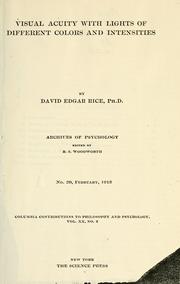 Visual acuity with lights of different colors and intensitiesDavid Edgar Rice · 1912
 Applied concepts in vision therapy, with accompanying diskLeonard J. Press · 1997
- 📕Visual acuity testing of radiographic inspectors in nondestructive inspectionGary Yonemura · 1981
- 📕Reaction time as a function of flash luminance and durationMark F. Lewis · 1967
 Bennett and Rabbetts' clinical visual opticsArthur G. Bennett · 1998
 Bennett and Rabbett's Clinical Visual OpticsRonald B. Rabbetts · 2007
- 📕Über die Sehschärfe im FlimmerlichtHugo Feilchenfeld · 1904
Ranked by number of editions on Open Library, a rough measure of how lasting a book is.
🔗 Related topics
- Snellen chart A Snellen chart is an eye chart that can be used to measure visual acuity. Snellen charts are named after the Dutch ophthalmologist Herman Snellen who…
- Eye chart An eye chart is a chart used to measure visual acuity comprising lines of optotypes in ranges of sizes. Optotypes are the letters or symbols shown on an…
- Fovea centralis The fovea centralis is a small, central pit composed of closely packed cones in the eye. It is located in the center of the macula lutea of the retina…
- Landolt C The Landolt C, also known as a Landolt ring, Landolt broken ring, or Japanese vision test, is an optotype—a standardized symbol used for testing vision…
- Peripheral vision Peripheral vision or indirect vision is vision as it occurs outside the point of fixation (i.e., away from the center of gaze) or, when viewed at large…
- Eye examination An eye examination, commonly known as an eye test, is a series of tests performed to assess vision and ability to focus on both far and near and discern…
- Stereoscopic acuity Stereoscopic acuity, also stereoacuity, is the smallest detectable depth difference that can be seen in binocular vision. Stereoacuity is most simply explained…
- Macula The macula (/ˈmækjʊlə/), in full macula lutea, is an oval-shaped pigmented area in the center of the retina of the human eye and in other animals. The…