Everything about Variance
Statistical measure of how far values spread from their average

In probability theory and statistics, variance is a measure of dispersion, meaning it is a measure of how far a set of numbers are spread out from their average value. It is defined as the expected value of the squared deviation from the mean of a random variable. The standard deviation is the square root of the variance. Technically, it is the second central moment of a distribution, and the covariance of the random variable with itself, and it is often represented by , , , , or . Wikipedia →
🧭 Start here: a 6-step reading path
- Read the overview: VarianceA 5-minute orientation
- Skim a recent paper: Bias correction for inverse variance weighting Mendelian randomizationInfluential work since 2022
- Pick up a classic book: Extending the Linear Model with RThe most-reprinted book on the subject
- Read the landmark paper: A new criterion for assessing discriminant validity in variance-based structural equation modelingCited 34,639 times
- Go sideways: Covariance matrixA closely related topic
- Go sideways: CovarianceA closely related topic
📖 Definitions
Noun The act of varying or the state of being variable.
Noun A difference between what is expected and what is observed; deviation.
Noun The state of differing or being in conflict.
Noun An official permit to do something that is ordinarily forbidden by regulations.
🏆 Landmark papers (most cited)
A new criterion for assessing discriminant validity in variance-based structural equation modeling
An analysis of variance test for normality (complete samples)
Autoregressive Conditional Heteroscedasticity with Estimates of the Variance of United Kingdom Inflation
Use of Ranks in One-Criterion Variance Analysis
A Caution Regarding Rules of Thumb for Variance Inflation Factors
Analysis of molecular variance inferred from metric distances among DNA haplotypes: application to human mitochondrial DNA restriction data.
Estimating the mean and variance from the median, range, and the size of a sample
The Use of Ranks to Avoid the Assumption of Normality Implicit in the Analysis of Variance
🆕 Influential since 2022
Bias correction for inverse variance weighting Mendelian randomization
A comprehensive review of thermoelectric generation optimization by statistical approach: Taguchi method, analysis of variance (ANOVA), and response surface methodology (RSM)
A variable selection method based on mutual information and variance inflation factor
Monte Carlo and variance reduction methods for structural reliability analysis: A comprehensive review
The Perceived Stress Scale as a Measure of Stress: Decomposing Score Variance in Longitudinal Behavioral Medicine Studies
📚 Books worth reading
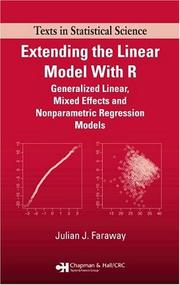 Extending the Linear Model with RJulian J. Faraway · 2004
 Design and analysis of experimentsDouglas C. Montgomery · 1976
 Linear ModelsShayle R. Searle · 1997
 Econometric methodsJohnston, J. · 1963
 Introductory statisticsN. A. Weiss · 1982
 Statistical methods for rates and proportionsJoseph L. Fleiss · 1973
 Plane answers to complex questionsRonald Christensen · 1987
- 📕Linear Models with RJulian J. Faraway · 2004
Ranked by number of editions on Open Library, a rough measure of how lasting a book is.
🔗 Related topics
- Covariance matrix In probability theory and statistics, a covariance matrix (also known as auto-covariance matrix, dispersion matrix, variance matrix, or variance–covariance…
- Covariance In probability theory and statistics, covariance is a measure of the joint variability of two random variables. The sign of the covariance shows the tendency…
- Central limit theorem In probability theory, the central limit theorem (CLT) states that, under appropriate conditions, the distribution of a normalized version of the sample…
- Delta method In statistics, the delta method is a method of deriving the asymptotic distribution of a random variable. It is applicable when the random variable being…
- Algebra of random variables In statistics, the algebra of random variables provides rules for the symbolic manipulation of random variables, while avoiding delving too deeply into…
- Weighted arithmetic mean The weighted arithmetic mean is similar to an ordinary arithmetic mean (the most common type of average), except that instead of each of the data points…
- Standard deviation In statistics, the standard deviation is a measure of the amount of variation of the values of a variable about its (arithmetic) average. A low standard…
- Simple linear regression In statistics, simple linear regression (SLR) is a linear regression model with a single explanatory variable. That is, it concerns two-dimensional sample…