Live briefing

Everything about Thomas Reid
Scottish philosopher (1710–1796)
Thomas Reid was a Scottish philosopher best known for his philosophical method, his theory of perception, and its wide implications on epistemology, and as the developer and defender of an agent-causal theory of free will. He also focused extensively on ethics, theory of action, language and philosophy of mind. Wikipedia →
🧭 Start here: a 6-step reading path
- Read the overview: Thomas ReidA 5-minute orientation
- Skim a recent paper: Thomas Reid, Thomas Reid and the UniversityInfluential work since 2022
- Pick up a classic book: Thomas Reid and ScepticismThe most-reprinted book on the subject
- Read the landmark paper: The faculty psychology of Thomas ReidCited 18 times
- Go sideways: Essays on the Active Powers of the Human MindA closely related topic
- Go sideways: Scottish common sense realismA closely related topic
📖 Definitions
No dictionary entry for this exact phrase.
🗂️ The subject at a glance
🏆 Landmark papers (most cited)
The faculty psychology of Thomas Reid
THOMAS REID ON ACQUIRED PERCEPTION
Thomas Reid on Free Agency
Thomas Reid and Philosophy with Children
Is Thomas Reid a Mysterian?
Common sense in Thomas Reid
An Inquiry into Thomas Reid
THOMAS REID ON MOLYNEUX'S QUESTION
🆕 Influential since 2022
📚 Books worth reading
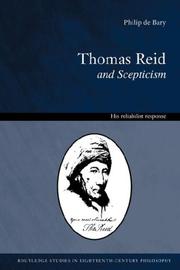 Thomas Reid and ScepticismPhilip De Bary · 2001
 New Essays on Thomas ReidPatrick Rysiew · 2015
 The salvagerMary Frances Doner · 1958
 The Cambridge companion to Thomas ReidTerence Cuneo, René van Woudenberg · 2004
- 📕Thomas Reid on Society and PoliticsThomas Reid, Knud Haakonssen · 2014
 Highland JourneyMairi Hedderwick · 1992
 Thomas ReidLehrer, Keith. · 1989
- 📕Thomas Reid and the Problem of Secondary QualitiesChristopher A. Shrock · 2017
Ranked by number of editions on Open Library, a rough measure of how lasting a book is.
🔗 Related topics
- Essays on the Active Powers of the Human Mind Essays on the Active Powers of the Human Mind is a book written by the Scottish philosopher Thomas Reid. The first edition was published in 1788 in Edinburgh…
- Scottish common sense realism Scottish common sense realism, also known as the Scottish school of common sense, is a realist school of philosophy that originated in the ideas of Scottish…
- Scottish philosophy Scottish philosophy is a philosophical tradition created by philosophers belonging to Scottish universities. Although many philosophers such as Francis…
- Empiricism Empiricism is an epistemological view in philosophy which holds that true knowledge or justification comes either only or primarily from sensory experience…
- Philosophical realism Philosophical realism—usually not treated as a position of its own but as a stance towards other subject matters—is the view that a certain kind of thing…
- Moral sense theory Moral sense theory (also known as moral sentimentalism) is a theory in moral epistemology and meta-ethics concerning the discovery of moral truths. Moral…
- Common sense Common sense (from Latin sensus communis) is "knowledge, judgement, and taste which is more or less universal and which is held more or less without reflection…
- George Campbell (18th-century minister) George Campbell FRSE (25 December 1719 – 6 April 1796) was a Scottish Enlightenment philosopher, minister, and professor of divinity. Campbell was primarily…