Everything about Team-based learning
Learning and teaching strategy
Team-based learning (TBL) is a collaborative learning and teaching strategy that enables people to follow a structured process to enhance student engagement and the quality of student or trainee learning. The term and concept was first popularized by Larry Michaelsen, the central figure in the development of the TBL method while at University of Oklahoma in the 1970s, as an educational strategy that he developed for use in academic settings, as in medical education. Team-based learning methodology can be used in any classroom or training sessions at school or in the workplace. Wikipedia →
🧭 Start here: a 6-step reading path
- Read the overview: Team-based learningA 5-minute orientation
- Skim a recent paper: Team‐Based Learning in Prosthodontics Courses: Students’ SatisfactionInfluential work since 2022
- Pick up a classic book: Team-based learning for health professions educationThe most-reprinted book on the subject
- Read the landmark paper: Team‐based learningCited 198 times
- Go sideways: Active learningA closely related topic
- Go sideways: Flipped classroomA closely related topic
📖 Definitions
No dictionary entry for this exact phrase.
🗂️ The subject at a glance
🏆 Landmark papers (most cited)
Team‐based learning
Team-Based Learning: Systematic Research Review
Team cohesiveness, team size and team performance in team‐based learning teams
Team-based Learning in Pharmacotherapeutics
Team-Based Inquiry Learning
Insights on Team-Based Learning
Team‐Based Learning for Midwifery Education
Choice-based learning: lecture-based or team learning?
🆕 Influential since 2022
Team‐Based Learning in Prosthodontics Courses: Students’ Satisfaction
Relationship between team learning profiles and outcomes in team project-based learning: a cluster analysis
Implementing Team-Based Learning: Findings From a Database Class
Adapting Team-Based Learning for an Online Biochemistry Course
Knowledge Sharing Behavior of Team Members in Blended Team-Based Learning: Moderating of Team Learning Ability
📚 Books worth reading
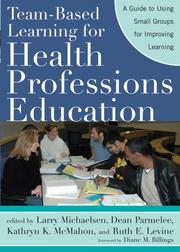 Team-based learning for health professions educationDean X. Parmelee, Diane M. Billings · 2007
 Developing the reflective healthcare teamTony Ghaye · 2005
 Orchestrating Collaboration at WorkArthur B. VanGundy, Linda Naiman · 2003
 Active learningMelvin L. Silberman · 1996
 Computer games and team and individual learning · 2007
- 📕Computer games and team and individual learningHarold F. O'Neil · 2008
 Teaching and Learning STEMRichard M. Felder, Rebecca Brent · 2024
 Brainball Teaching Inquiry Science As A Team Sport Science EditionMickey Kolis · 2014
Ranked by number of editions on Open Library, a rough measure of how lasting a book is.
🔗 Related topics
- Active learning Active learning is "a method of learning in which students are actively or experientially involved in the learning process and where there are different…
- Flipped classroom A flipped classroom is an instructional strategy and a type of blended learning. It aims to increase student engagement and learning by having pupils complete…
- Passive learning Passive learning is a teaching method where students receive information from the instructor and internalize it. It is a method "where the learner receives…
- Teaching method A teaching method is a set of principles and methods used by teachers to enable student learning. These strategies are determined partly by the subject…
- Problem-based learning Problem-based learning (PBL) is a teaching method in which students aim to learn about a subject through the experience of solving an open-ended problem…
- Project-based learning Project-based learning is a teaching method that uses a dynamic classroom approach in which students acquire deeper knowledge through active exploration…
- Learning-by-doing Learning by doing is a theory that places heavy emphasis on student engagement and is a hands-on, task-oriented, process to education. The theory refers…
- Constructivist teaching methods Constructivist teaching is based on constructivism. It rests on the belief that learning occurs as learners are actively involved in a process of meaning…