Everything about Sequential minimal optimization
Algorithm for solving the quadratic programming problem from training SVMs
Sequential minimal optimization (SMO) is an algorithm for solving the quadratic programming (QP) problem that arises during the training of support-vector machines (SVM). It was invented by John Platt in 1998 at Microsoft Research. SMO is widely used for training support vector machines and is implemented by the popular LIBSVM tool. The publication of the SMO algorithm in 1998 has generated a lot of excitement in the SVM community, as previously available methods for SVM training were much more complex and required expensive third-party QP solvers. Wikipedia →
🧭 Start here: a 6-step reading path
- Read the overview: Sequential minimal optimizationA 5-minute orientation
- Skim a recent paper: SVM-SMO-SGD: A hybrid-parallel support vector machine algorithm using sequential minimal optimization with stochastic gradient descentInfluential work since 2022
- Pick up a classic book: Game TheoryThe most-reprinted book on the subject
- Read the landmark paper: Sequential minimal optimization for quantum-classical hybrid algorithmsCited 192 times
- Go sideways: Least-squares support vector machineA closely related topic
- Go sideways: Linear complementarity problemA closely related topic
📖 Definitions
No dictionary entry for this exact phrase.
🗂️ The subject at a glance
🏆 Landmark papers (most cited)
Sequential minimal optimization for quantum-classical hybrid algorithms
Parallel Sequential Minimal Optimization for the Training of Support Vector Machines
Machine Learning-Based Anomaly Detection Using K-Mean Array and Sequential Minimal Optimization
Sequential minimal optimization for SVM with pinball loss
Credit Card Fraud Detection Using Fuzzy Rough Nearest Neighbor and Sequential Minimal Optimization with Logistic Regression
VLSI Design of an SVM Learning Core on Sequential Minimal Optimization Algorithm
Predicting the types of metabolic pathway of compounds using molecular fragments and sequential minimal optimization
Minimal crystallographic descriptors of sorption properties in hypothetical MOFs and role in sequential learning optimization
🆕 Influential since 2022
SVM-SMO-SGD: A hybrid-parallel support vector machine algorithm using sequential minimal optimization with stochastic gradient descent
Improved accuracy and less fault prediction errors via modified sequential minimal optimization algorithm
Transient stability assessment in bulk power grids using sequential minimal optimization based support vector machine with pinball loss
Fractional Order Sequential Minimal Optimization Classification Method
Sequential Minimal Optimization Algorithm for One-Class Support Vector Machines With Privileged Information
📚 Books worth reading
 Game TheoryMichael Maschler, Eilon Solan · 2013
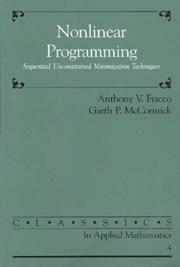 Nonlinear programmingAnthony V. Fiacco · 1968
 Diagnosis and PredictionSeymour Geisser · 1999
 Tools and Algorithms for the Construction and Analysis of SystemsNir Piterman · 2013
- 📕Sequential unconstrained minimization technique (SUMT) for optimal production planningFrank T. Hsu · 1971
- 📕Nonlinear programmingAnthony V. Fiacco · 1968
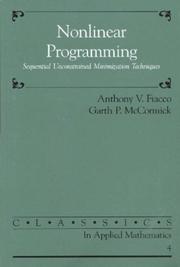 Nonlinear programming · 1987
 Fundamental Engineering Optimization MethodsFun Kamran Iqbal · 2013
Ranked by number of editions on Open Library, a rough measure of how lasting a book is.
🔗 Related topics
- Least-squares support vector machine Least-squares support-vector machines (LS-SVM) for statistics and in statistical modeling, are least-squares versions of support-vector machines (SVM)…
- Linear complementarity problem In mathematical optimization theory, the linear complementarity problem (LCP) arises frequently in computational mechanics and encompasses the well-known…
- Sequential quadratic programming Sequential quadratic programming (SQP) is an iterative method for constrained nonlinear optimization, also known as Lagrange-Newton method. SQP methods…
- Support vector machine In machine learning, a support vector machine (SVM) or support vector network is a supervised max-margin model with associated learning algorithms that…
- Quadratic programming Quadratic programming (QP) is the process of solving certain mathematical optimization problems involving quadratic functions. Specifically, one seeks…
- Active-set method In mathematical optimization, the active-set method is an algorithm used to identify the active constraints in a set of inequality constraints. The active…
- List of numerical analysis topics This is a list of numerical analysis topics. Validated numerics Iterative method Rate of convergence — the speed at which a convergent sequence approaches…
- Augmented Lagrangian method Augmented Lagrangian methods are a certain class of algorithms for solving constrained optimization problems. They have similarities to penalty methods…