Live briefing
Everything about Scheduling (computing)
Method by which work is assigned
In computing, scheduling is the action of assigning resources to perform tasks. The resources may be processors, network links or expansion cards. The tasks may be threads, processes or data flows. Wikipedia →
🧭 Start here: a 6-step reading path
- Read the overview: Scheduling (computing)A 5-minute orientation
- Skim a recent paper: Deep Reinforcement Learning-Based Workload Scheduling for Edge ComputingInfluential work since 2022
- Pick up a classic book: Job scheduling strategies for parallel processingThe most-reprinted book on the subject
- Read the landmark paper: Performance-effective and low-complexity task scheduling for heterogeneous computingCited 3,068 times
- Go sideways: Completely Fair SchedulerA closely related topic
- Go sideways: Brain Fuck SchedulerA closely related topic
📖 Definitions
No dictionary entry for this exact phrase.
🏆 Landmark papers (most cited)
Performance-effective and low-complexity task scheduling for heterogeneous computing
Mobility-Aware Application Scheduling in Fog Computing
Task scheduling in cloud-fog computing systems
Task scheduling for heterogeneous computing systems
Survey on Scheduling Issues in Cloud Computing
Iterative list scheduling for heterogeneous computing
Heterogeneous computing scheduling with evolutionary algorithms
DAG Scheduling in Mobile Edge Computing
🆕 Influential since 2022
Deep Reinforcement Learning-Based Workload Scheduling for Edge Computing
Hierarchical Scheduling Mechanisms in Multi-Level Fog Computing
Multi-Agent Cooperation for Computing Power Scheduling in UAVs Empowered Aerial Computing Systems
Combined Communication and Computing Resource Scheduling in Sliced 5G Multi-Access Edge Computing Systems
Local Scheduling in KubeEdge-Based Edge Computing Environment
📚 Books worth reading
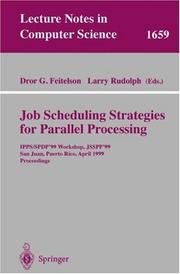 Job scheduling strategies for parallel processingJSSPP'99 (1999 San Juan, P.R.), IPPS/SPDP '98 Workshop (1998 Orlando, Fla.) · 1995
 Embedded multiprocessorsSundararajan Sriram, Sundararajan Sriram · 2000
 Total workday control using Microsoft OutlookMichael Linenberger · 2006
 The Beginner's GuideDavid C. McKay · 1995
 Scheduling algorithmsPeter Brucker · 1995
- 📕Run-time parallelization and scheduling of loopsJoel Saltz · 1988
 Multiagent SchedulingAlessandro Agnetis, Jean-Charles Billaut · 2014
 Deadline scheduling for real-time systemsJohn A. Stankovic · 1998
Ranked by number of editions on Open Library, a rough measure of how lasting a book is.
🔗 Related topics
- Completely Fair Scheduler The Completely Fair Scheduler (CFS) was a process scheduler that was merged into the 2.6.23 (October 2007) release of the Linux kernel. It was the default…
- Brain Fuck Scheduler The Brain Fuck Scheduler (BFS) is a process scheduler designed for the Linux kernel in August 2009 based on earliest eligible virtual deadline first scheduling…
- O(1) scheduler An O(1) scheduler (pronounced "O of 1 scheduler", "Big O of 1 scheduler", or "constant time scheduler") using the terminology from Big O notation in algorithm…
- Real-time operating system A real-time operating system (RTOS) is an operating system (OS) for real-time computing applications that processes data and events that have critically…
- Micro-Controller Operating Systems Micro-Controller Operating Systems (MicroC/OS, stylized as μC/OS, or Micrium OS) is a real-time operating system (RTOS) designed by Jean J. Labrosse in…
- Context switch In computing, a context switch is the process of storing the state of a process or thread, so that it can be restored and resume execution at a later point…
- Preemption (computing) In computing, preemption is the act performed by an external scheduler — without assistance or cooperation from the task — of temporarily interrupting…
- Multilevel feedback queue In computer science, a multilevel feedback queue is a scheduling algorithm. Scheduling algorithms are designed to have some process running at all times…