Live briefing
Everything about Probit model
Statistical regression where the dependent variable can take only two values
In statistics, a probit model is a type of regression where the dependent variable can take only two values. The word is a portmanteau, coming from probability + unit. The purpose of the model is to estimate the probability that an observation with particular characteristics will fall into a specific one of the categories; moreover, classifying observations based on their predicted probabilities is a type of binary classification model. Wikipedia →
🧭 Start here: a 6-step reading path
- Read the overview: Probit modelA 5-minute orientation
- Skim a recent paper: A spatial rank-ordered probit model with an application to travel mode choiceInfluential work since 2022
- Pick up a classic book: Simultane Probit- und TobitmodelleThe most-reprinted book on the subject
- Read the landmark paper: Statistical inference in the multinomial multiperiod probit modelCited 122 times
- Go sideways: Tobit modelA closely related topic
- Go sideways: Logistic regressionA closely related topic
📖 Definitions
No dictionary entry for this exact phrase.
🗂️ The subject at a glance
🏆 Landmark papers (most cited)
Statistical inference in the multinomial multiperiod probit model
Estimation of the Two-Limit Probit Regression Model
Accident severity analysis using ordered probit model
Pseudo-R2's in the ordinal probit model
Estimability in the multinomial probit model
A probit-based stochastic user equilibrium assignment model
Probit and Logit Model Selection
Small Sample Properties of Probit Model Estimators
🆕 Influential since 2022
A spatial rank-ordered probit model with an application to travel mode choice
New estimators for the probit regression model with multicollinearity
Motivations for women’s participation in urban agriculture: a multivariate probit model analysis
A multinomial probit model with Choquet integral and attribute cut-offs
Risk assessment of liquid ammonia tanks based on Bayesian network and Probit model
📚 Books worth reading
- 📕Simultane Probit- und TobitmodelleWinfried Pohlmeier · 1989
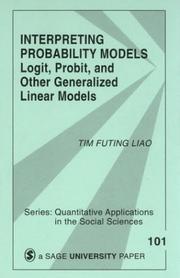 Interpreting probability modelsTim Futing Liao · 1994
 An introduction to the interpretation of quantal responses in biologyPaul Soames Hewlett · 1979
 Multinomial probitCarlos Daganzo · 1979
 Logit- und Probitregression mit Fehlern in den VariabelnHelmut Küchenhoff · 1990
- 📕Convenient specification tests for logit and probit modelsRussell Davidson · 1983
- 📕The dichotomous dependent variableMoffat Patrick Witherington · 1978
- 📕Travel demand modelsNils Bruzelius · 1981
Ranked by number of editions on Open Library, a rough measure of how lasting a book is.
🔗 Related topics
- Tobit model In statistics, a tobit model is any of a class of regression models in which the observed range of the dependent variable is censored in some way. The…
- Logistic regression In statistics, a logistic model (or logit model) is a statistical model that models the log-odds of an event as a linear combination of one or more independent…
- Binomial regression In statistics, binomial regression is a regression analysis technique in which the response (often referred to as Y) has a binomial distribution: it is…
- Ordinal regression In statistics, ordinal regression, also called ordinal classification, is a type of regression analysis used for predicting an ordinal variable, i.e. a…
- Maximum score estimator In statistics and econometrics, the maximum score estimator is a nonparametric estimator for discrete choice models developed by Charles Manski in 1975…
- Binary regression In statistics, specifically regression analysis, a binary regression estimates a relationship between one or more explanatory variables and a single output…
- Generalized linear model In statistics, a generalized linear model (GLM) is a flexible generalization of ordinary linear regression. The GLM generalizes linear regression by allowing…
- Linear probability model In statistics, a linear probability model (LPM) is a special case of a binary regression model. Here the dependent variable for each observation takes…