Live briefing

Everything about Oracle bone
Shells and bones used for divination in ancient China
Oracle bones are pieces of ox scapula and turtle plastron which were used in pyromancy – a form of divination – during the Late Shang period in ancient China. Scapulimancy is the specific term if ox scapulae were used for the divination, plastromancy if turtle plastrons were used. A recent count estimated that there were about 13,000 bones with a total of a little over 130,000 inscriptions in collections in China and some fourteen other countries. Wikipedia →
🧭 Start here: a 6-step reading path
- Read the overview: Oracle boneA 5-minute orientation
- Skim a recent paper: Dynamic Dataset Augmentation for Deep Learning-based Oracle Bone Inscriptions RecognitionInfluential work since 2022
- Pick up a classic book: Jia gu wen liThe most-reprinted book on the subject
- Read the landmark paper: HWOBC-A Handwriting Oracle Bone Character Recognition DatabaseCited 39 times
- Go sideways: Oracle bone scriptA closely related topic
- Go sideways: Shang dynasty religious practitionersA closely related topic
📖 Definitions
Noun A piece of turtle shell or bone used for divination during the late Shang dynasty of China.
🏆 Landmark papers (most cited)
HWOBC-A Handwriting Oracle Bone Character Recognition Database
The Shang State as Seen in the Oracle-Bone Inscriptions
Detecting oracle bone inscriptions via pseudo-category labels
Distinguishing Oracle Variants Based on the Isomorphism and Symmetry Invariances of Oracle-Bone Inscriptions
Image Translation for Oracle Bone Character Interpretation
Internal Similarity Network for Rejoining Oracle Bone Fragment Images
Oracle-Bone Inscription Recognition Based on Deep Convolutional Neural Network
Linking unknown characters via oracle bone inscriptions retrieval
🆕 Influential since 2022
Dynamic Dataset Augmentation for Deep Learning-based Oracle Bone Inscriptions Recognition
An open dataset for oracle bone character recognition and decipherment
Improvement of Oracle Bone Inscription Recognition Accuracy: A Deep Learning Perspective
Recognition of Oracle Bone Inscriptions by using Two Deep Learning Models
An Oracle Bone Inscriptions Detection Algorithm Based on Improved YOLOv8
📚 Books worth reading
- 📕Jia gu wen liGuangwei Hu · 1928
- 📕Tian rang ge jia gu wen cun bing kao shiTang, Lan · 1939
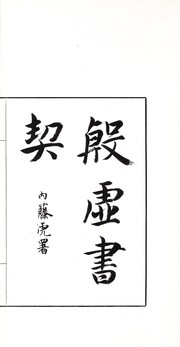 Yin xu shu qiZhenyu Luo · 1912
- 📕Jia gu xue Shang shi lun congHouxuan Hu · 1945
- 📕Jian ming jia gu wen ci dianHengsheng Cui · 1992
- 📕A technical glossary of jiaguology (oracle bone studies)Riccardo Fracasso · 1988
- 📕Jia gu xu cunHouxuan Hu · 1955
- 📕Jian shou tang suo cang Yin Xu wen zi kao shiYan, Yiping. · 1980
Ranked by number of editions on Open Library, a rough measure of how lasting a book is.
🔗 Related topics
- Oracle bone script The oracle bone script is the oldest attested form of written Chinese, dating to the late 2nd millennium BC. Inscriptions were made by carving characters…
- Shang dynasty religious practitioners The Shang dynasty of China (c. 1600 – c. 1046 BCE), which adhered to a polytheistic religion centered around worshipping ancestors, structured itself into…
- Ritual and worship in the Shang dynasty The ritual and worship in the Shang dynasty (c. 1600 – c. 1046 BC), the second royal dynasty of China, comprised the acts through which the Shang worshipped…
- Shang dynasty The Shang dynasty (Chinese: 商朝; pinyin: Shāngcháo), also known as the Yin dynasty (殷代; Yīn dài), was a Chinese royal dynasty that ruled in the Yellow River…
- Late Shang The Late Shang, also known as the Anyang period, is the earliest known literate civilization in China, spanning the reigns of the last nine kings of the…
- Zheng (diviner) Zheng (爭) was a prominent diviner during the Shang dynasty, appearing in over 800 oracle bone inscriptions. They are known to have served Wu Ding and Zu…
- Yinxu Yinxu (Mandarin pronunciation: [ín.ɕý]; Chinese: 殷墟; lit. 'Ruins of Yin') is a Chinese archeological site corresponding to Yin, the final capital of the…
- Religion of the Shang dynasty The state religion of the Shang dynasty (c. 1600 – c. 1046 BC), the second royal dynasty of China, involved trained practitioners communicating with deities…