Live briefing
Everything about Operant conditioning
Type of associative learning process for behavioral modification
Operant conditioning, also called instrumental conditioning, is a learning process in which voluntary behaviors are modified by association with the addition of reward or aversive stimuli. The frequency or duration of the behavior may increase through reinforcement or decrease through punishment or extinction. Wikipedia →
🧭 Start here: a 6-step reading path
- Read the overview: Operant conditioningA 5-minute orientation
- Skim a recent paper: Memristor-Based Operant Conditioning Neural Network With Blocking and Competition EffectsInfluential work since 2022
- Pick up a classic book: Oecd Economic SurveysThe most-reprinted book on the subject
- Read the landmark paper: Operant ConditioningCited 341 times
- Go sideways: ReinforcementA closely related topic
- Go sideways: Motivational salienceA closely related topic
📖 Definitions
Noun A technique of behavior modification through positive and negative reinforcement and positive and negative punishment.
🏆 Landmark papers (most cited)
Operant Conditioning
Operant conditioning in invertebrates
Operant Conditioning in Skinnerbots
The dynamics of operant conditioning.
Operant Conditioning of Heart Rate
Operant Conditioning of Vasoconstriction.
Operant conditioning treatment of encopresis
Operant conditioning of the GSR.
🆕 Influential since 2022
Memristor-Based Operant Conditioning Neural Network With Blocking and Competition Effects
Memristor-Based Neural Network Circuit of Operant Conditioning Accorded With Biological Feature
Neuromorphic Circuit Implementation of Operant Conditioning Based on Emotion Generation and Modulation
Memristive Circuit Implementation of Operant Cascaded With Classical Conditioning
Operant Conditioning Neuromorphic Circuit With Addictiveness and Time Memory for Automatic Learning
📚 Books worth reading
 Oecd Economic SurveysOrganisation for Economic Co-operation and Development · 1980
 Oecd Economic SurveysOrganisation for Economic Co-operation and Development · 1995
 Rural Denmark and its lessonsH. Rider Haggard · 1911
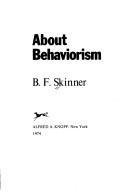 About behaviourismB. F. Skinner · 1974
- 📕Operant conditioningDerek E. Blackman · 1974
 The infiltratorRobert Mazur · 2009
 Handbook of operant behaviorWerner K. Honig, J. E. R. Staddon · 1977
 Contemporary learning theoriesStephen B. Klein · 1989
Ranked by number of editions on Open Library, a rough measure of how lasting a book is.
🔗 Related topics
- Reinforcement In behavioral psychology, reinforcement refers to consequences that increase the likelihood of an organism's future behavior, typically in the presence…
- Motivational salience Motivational salience is a cognitive process and a form of attention that motivates or propels an individual's behavior towards or away from a particular…
- Experimental analysis of behavior The experimental analysis of behavior is a science that studies the behavior of individuals across a variety of species. A key early scientist was B. F…
- Extinction (psychology) Extinction in psychology refers to the gradual decrease and possible elimination of a learned behavior. This behavioral phenomenon can be observed in both…
- Avoidance response An avoidance response is a response that prevents an aversive stimulus from occurring. It is a kind of negative reinforcement. An avoidance response is…
- Punishment (psychology) Punishment is any change in a human or animal's surroundings which, occurring after a given behavior or response, reduces the likelihood of that behavior…
- Pavlovian-instrumental transfer Pavlovian-instrumental transfer (PIT) is a psychological phenomenon that occurs when a conditioned stimulus (CS, also known as a "cue") that has been associated…
- Stimulus control In behavioral psychology, stimulus control is a phenomenon in operant conditioning that occurs when an organism behaves in one way in the presence of a…