Everything about Obversion
Immediate inference in logic
In traditional logic, obversion is a "type of immediate inference in which from a given proposition another proposition is inferred whose subject is the same as the original subject, whose predicate is the contradictory of the original predicate, and whose quality is affirmative if the original proposition's quality was negative and vice versa". The quality of the inferred categorical proposition is changed but the truth value is the same to the original proposition. The immediately inferred proposition is termed the "obverse" of the original proposition, and is a valid form of inference for all types of categorical propositions. Wikipedia →
🧭 Start here: a 6-step reading path
- Read the overview: ObversionA 5-minute orientation
- Pick up a classic book: The Power of LogicThe most-reprinted book on the subject
- Read the landmark paper: A NOTE ON OBVERSIONCited 2 times
- Go sideways: Categorical propositionA closely related topic
- Go sideways: ContrapositionA closely related topic
📖 Definitions
Noun The act of turning toward or downward.
Noun An immediate inference that denies the opposite of something previously affirmed.
🗂️ The subject at a glance
No outline available.
🏆 Landmark papers (most cited)
📚 Books worth reading
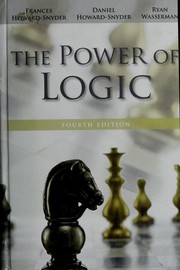 The Power of LogicFrances Howard-Snyder, Daniel Howard-Snyder · 2009
- 📕ObverseChristine Ashby · 2020
 Figures of literary discourseGérard Genette · 1982
- 📕'Perle' and 'souillon'Susan Claire Yates · 1988
- 📕Zenith Lives! (Obverse Quarterly)Michael Moorcock
- 📕ObverseWill Daunt · 2022
- 📕Obversations 1Struan McAteer · 2001
 The obversant voyageO. Brian Patrick · 2005
Ranked by number of editions on Open Library, a rough measure of how lasting a book is.
🔗 Related topics
- Categorical proposition In logic, a categorical proposition, or categorical statement, is a proposition that asserts or denies that all or some of the members of one category…
- Contraposition In logic and mathematics, contraposition, or transposition, refers to the inference of going from a conditional statement into its logically equivalent…
- Square of opposition In term logic (a branch of philosophical logic), the square of opposition is a diagram representing the relations between the four basic categorical proposition…
- Converse (logic) In logic and mathematics, the converse of a categorical or implicational statement is the result of reversing its two constituent statements. For the implicatio…
- Syllogism A syllogism (Ancient Greek: συλλογισμός, syllogismos, 'conclusion, inference') is a kind of logical argument that applies deductive reasoning to arrive…
- Inverse (logic) In logic, an inverse is a type of conditional sentence which is an immediate inference made from another conditional sentence. More specifically, given…
- The False Subtlety of the Four Syllogistic Figures The False Subtlety of the Four Syllogistic Figures Proved (German: Die falsche Spitzfindigkeit der vier syllogistischen Figuren erwiesen) is an essay published…
- Term logic In logic and formal semantics, term logic, also known as traditional logic, syllogistic logic or Aristotelian logic, is a loose name for an approach to…