Live briefing
Everything about Contraposition
Mathematical logic concept
In logic and mathematics, contraposition, or transposition, refers to the inference of going from a conditional statement into its logically equivalent contrapositive, and an associated proof method known as § Proof by contrapositive. The contrapositive of a statement has its antecedent and consequent negated and swapped. Wikipedia →
🧭 Start here: a 6-step reading path
- Read the overview: ContrapositionA 5-minute orientation
- Skim a recent paper: Evidential Support and ContrapositionInfluential work since 2022
- Pick up a classic book: Mathematical structures for computer scienceThe most-reprinted book on the subject
- Read the landmark paper: Undergraduate students' understanding of the contraposition equivalence rule in symbolic and verbal contextsCited 58 times
- Go sideways: Inverse (logic)A closely related topic
- Go sideways: Converse (logic)A closely related topic
📖 Definitions
Noun The statement of the form "if not Q then not P", given the statement "if P then Q".
Noun Opposition; contrast.
🏆 Landmark papers (most cited)
Undergraduate students' understanding of the contraposition equivalence rule in symbolic and verbal contexts
Displaying and Deciding Substructural Logics 1: Logics with Contraposition
Rationality, transitivity, and contraposition
Meaning-preserving contraposition of natural language conditionals
Stability analysis of sampled-data systems via open-/closed-loop characteristic polynomials contraposition
Extending the Contraposition Property of Propositional Logic for Fuzzy Abduction
Fārābī and Avicenna on Contraposition
Contraposition in European and Indian Logic
🆕 Influential since 2022
Evidential Support and Contraposition
On Fuzzy Negations and Laws of Contraposition. Lattice of Fuzzy Negations
Characterizations of fuzzy implications by the laws of contraposition
Representations of the fuzzy implications satisfying the law of left or right contraposition
Correction to: Evidential Support and Contraposition
📚 Books worth reading
 Mathematical structures for computer scienceJudith L. Gersting · 1982
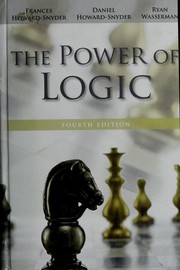 The Power of LogicFrances Howard-Snyder, Daniel Howard-Snyder · 2009
 Introduction to automata theory, languages, and computationJohn E. Hopcroft, Jeffrey D. Ullman · 1979
 Principles of logicGeorge Hayward Joyce · 1908
 An elementary handbook of logicToohey, John Joseph · 1918
 Socratic logicPeter Kreeft · 2003
 How Things PersistKatherine Hawley · 2002
 A Doubter's AlmanacEthan Canin · 2016
Ranked by number of editions on Open Library, a rough measure of how lasting a book is.
🔗 Related topics
- Inverse (logic) In logic, an inverse is a type of conditional sentence which is an immediate inference made from another conditional sentence. More specifically, given…
- Converse (logic) In logic and mathematics, the converse of a categorical or implicational statement is the result of reversing its two constituent statements. For the implicatio…
- Modus tollens In propositional logic, modus tollens (/ˈmoʊdəs ˈtɒlɛnz/) (MT), also known as modus tollendo tollens (Latin for "mode that by denying denies") and denying…
- Categorical proposition In logic, a categorical proposition, or categorical statement, is a proposition that asserts or denies that all or some of the members of one category…
- Resolution (logic) In mathematical logic and automated theorem proving, resolution is a rule of inference leading to a sound and refutation-complete theorem-proving technique…
- Obversion In traditional logic, obversion is a "type of immediate inference in which from a given proposition another proposition is inferred whose subject is the…
- Material implication (rule of inference) In classical propositional logic, material implication is a valid rule of replacement that allows a conditional statement to be replaced by a disjunction…
- Vacuous truth In mathematics and logic, a vacuous truth is a conditional or universal statement (specifically a universal statement that can be converted to a conditional…