Live briefing
Everything about Native-language identification
Determining an author's first language
Native-language identification (NLI) is the task of determining an author's native language (L1) based only on their writings in a second language (L2). NLI works through identifying language-usage patterns that are common to specific L1 groups and then applying this knowledge to predict the native language of previously unseen texts. This is motivated in part by applications in second-language acquisition, language teaching and forensic linguistics, amongst others. Wikipedia →
🧭 Start here: a 6-step reading path
- Read the overview: Native-language identificationA 5-minute orientation
- Skim a recent paper: Native language identification for Indian-speakers by an ensemble of phoneme-specific, and text-independent convolutionsInfluential work since 2022
- Pick up a classic book: The meaning of differenceThe most-reprinted book on the subject
- Read the landmark paper: Differential neural contributions to native- and foreign-language talker identification.Cited 33 times
- Go sideways: Natural language processingA closely related topic
- Go sideways: Language identificationA closely related topic
📖 Definitions
No dictionary entry for this exact phrase.
🗂️ The subject at a glance
🏆 Landmark papers (most cited)
Differential neural contributions to native- and foreign-language talker identification.
Native Language Identification With Classifier Stacking and Ensembles
Native Language Identification in Very Short Utterances Using Bidirectional Long Short-Term Memory Network
Multilingual native language identification
The native-language benefit for talker identification is robust in 7.5-month-old infants.
Native Language Identification of Fluent and Advanced Non-Native Writers
Multitask deep learning for native language identification
Native language identification and writing proficiency
🆕 Influential since 2022
Native language identification for Indian-speakers by an ensemble of phoneme-specific, and text-independent convolutions
Negative Language Transfer Identification in the English Writing of Chinese and Farsi Native Speakers
String Kernel-Based Techniques for Native Language Identification
Native language identification from text using a fine-tuned GPT-2 model
Identification of the native language of a person
📚 Books worth reading
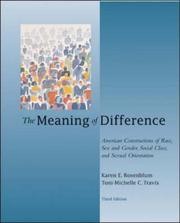 The meaning of differenceKaren E. Rosenblum, Toni-Michelle Travis · 1995
 The Indian AntiquaryJames Burgess, Richard Carnac Temple · 1893
 Treaty Occupationay ToxicologySuelen Queiroz · 2010
 New trends & issues in teaching Japanese language & cultureKyoko Kijirida, Mildred Tahara · 1997
 Theoretical analyses on Romance languagesLinguistic Symposium on Romance Languages (26th 1996 Mexico City, Mexico) · 1998
- 📕Multicultural law enforcementRobert M. Shusta · 2011
 Essential Speech and Language Technology for DutchPeter Spyns · 2013
 Cross-Cultural Design. Methods, Practice, and Case StudiesP. L. Patrick Rau · 2013
Ranked by number of editions on Open Library, a rough measure of how lasting a book is.
🔗 Related topics
- Natural language processing Natural language processing (NLP) is the processing of natural language information by a computer. NLP is a subfield of computer science and is closely…
- Language identification In natural language processing, language identification or language guessing is the problem of determining which natural language a given content is in…
- Textual entailment In natural language processing, textual entailment (TE), also known as natural language inference (NLI), is a directional relation between text fragments…
- Second-language acquisition Second-language acquisition (SLA), second-language learning or L2 (language 2) acquisition, is the process of learning a language other than one's native…
- Contrastive analysis Contrastive analysis is the systematic study of a couple of languages with a view to identifying their structural differences and similarities. Historically…
- Interlanguage An interlanguage is an idiolect developed by a learner of a second language (L2) which preserves some features of their first language (L1) and can overgenerali…
- Language transfer Language transfer is the application of linguistic features from one language to another by a bilingual or multilingual speaker and may occur across both…
- Paraphrase A paraphrase (/ˈpærəˌfreɪz/) or rephrase is a rewording of a text that retains the original meaning. Paraphrasing can enhance clarity and effectiveness…