Live briefing
Everything about Monte Carlo algorithm
Type of randomized algorithm
In computing, a Monte Carlo algorithm is a randomized algorithm whose output may be incorrect with a certain probability. Two examples of such algorithms are the Karger–Stein algorithm and the Monte Carlo algorithm for minimum feedback arc set. Wikipedia →
🧭 Start here: a 6-step reading path
- Read the overview: Monte Carlo algorithmA 5-minute orientation
- Skim a recent paper: Single-step Monte Carlo criticality algorithmInfluential work since 2022
- Pick up a classic book: Ocean observations with EOS/MODISThe most-reprinted book on the subject
- Read the landmark paper: New Monte Carlo algorithm: Entropic samplingCited 487 times
- Go sideways: Solovay–Strassen primality testA closely related topic
- Go sideways: Randomized algorithmA closely related topic
📖 Definitions
No dictionary entry for this exact phrase.
🏆 Landmark papers (most cited)
New Monte Carlo algorithm: Entropic sampling
Generalized Lanczos algorithm for variational quantum Monte Carlo
“Worm” algorithm in quantum Monte Carlo simulations
A generalized guided Monte Carlo algorithm
Implementations of the Monte Carlo EM Algorithm
Fast Monte Carlo algorithm for supercooled soft spheres
An Optimal Algorithm for Monte Carlo Estimation
An improved Monte Carlo factorization algorithm
🆕 Influential since 2022
Single-step Monte Carlo criticality algorithm
Parameter tuning of the firefly algorithm by three tuning methods: Standard Monte Carlo, quasi-Monte Carlo and latin hypercube sampling methods
Validation of RayStation Monte Carlo dose calculation algorithm for multiple LINACs
Backpropagating Hybrid Monte Carlo algorithm for fast Lefschetz thimble calculations
A pseudo-marginal sequential Monte Carlo online smoothing algorithm
📚 Books worth reading
- 📕Ocean observations with EOS/MODISHoward R. Gordon · 1995
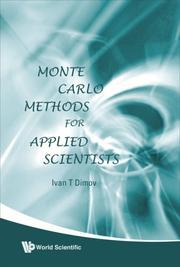 Monte Carlo methods for applied scientistsIvan T. Dimov, Sean McKee · 2005
 Monte Carlo and Quasi-Monte Carlo Methods 2010Leszek Plaskota · 2012
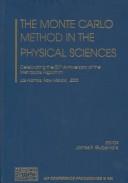 The Monte Carlo Method in the Physical SciencesJames E. Gubernatis · 2003
- 📕International Youth Workshop on Monte Carlo Methods and Parallel Algorithms, Primorsko, Bulgaria, 24-30 September 1989International Youth Workshop on Monte Carlo Methods and Parallel Algorithms (1st 1989 Primorsko, Bulgaria) · 1991
- 📕Metody Monte-Karlo dli͡a︡ raschetov glubokogo proniknovenii͡a︡ izlucheniĭA. V. Starkov · 1990
- 📕The detector response matrices of the burst and transient source experiment (BATSE) on the Compton Gamma Ray Observatory · 1995
 Explorations in Monte Carlo methodsRonald W. Shonkwiler · 2009
Ranked by number of editions on Open Library, a rough measure of how lasting a book is.
🔗 Related topics
- Solovay–Strassen primality test The Solovay–Strassen primality test, developed by Robert M. Solovay and Volker Strassen in 1977, is a probabilistic primality test to determine if a number…
- Randomized algorithm A randomized algorithm is an algorithm that employs a degree of randomness as part of its logic or procedure. The algorithm typically uses uniformly random…
- BPP (complexity) In computational complexity theory, a branch of computer science, bounded-error probabilistic polynomial time (BPP) is the class of decision problems solvable…
- Las Vegas algorithm In computing, a Las Vegas algorithm is a randomized algorithm that always gives correct results; that is, it always produces the correct result or it informs…
- Volker Strassen Volker Strassen (born April 29, 1936) is a German mathematician, a professor emeritus in the department of mathematics and statistics at the University…
- ZPP (complexity) In complexity theory, ZPP (zero-error probabilistic polynomial time) is the complexity class of problems for which a probabilistic Turing machine exists…
- Primality test A primality test is an algorithm for determining whether an input number is prime. Among other fields of mathematics, it is used for cryptography. Unlike…
- RP (complexity) In computational complexity theory, randomized polynomial time (RP) is the complexity class of decision problems for which a probabilistic Turing machine…