Everything about Homograph
Distinct words with identical written forms

A homograph is a word that shares the same written form as another word but has a different meaning. However, some dictionaries insist that the words must also be pronounced differently, while the Oxford English Dictionary says that the words should also be of "different origin". In this vein, The Oxford Guide to Practical Lexicography lists various types of homographs, including those in which the words are discriminated by being in a different word class, such as hit, the verb to strike, and hit, the noun a strike. Wikipedia →
🧭 Start here: a 6-step reading path
- Read the overview: HomographA 5-minute orientation
- Skim a recent paper: DomainNet: Homograph Detection and Understanding in Data Lake DisambiguationInfluential work since 2022
- Pick up a classic book: Homophones and homographsThe most-reprinted book on the subject
- Read the landmark paper: Interlingual homograph recognition: Effects of task demands and language intermixingCited 251 times
- Go sideways: HomonymA closely related topic
- Go sideways: Heteronym (linguistics)A closely related topic
📖 Definitions
Noun A word that is spelled the same as another word, usually having a different etymology.
Noun A text character or string that looks identical to another when rendered.
🗂️ The subject at a glance
🏆 Landmark papers (most cited)
Interlingual homograph recognition: Effects of task demands and language intermixing
On Being Blinded by Your Other Language: Effects of Task Demands on Interlingual Homograph Recognition
Selective access of homograph meanings in sentence context
The University of South Florida homograph norms
The homograph attack
Phonological activation in bilinguals: Evidence from interlingual homograph naming
More on interlingual homograph recognition: language intermixing versus explicitness of instruction
Interlingual homograph interference in German–English bilinguals: Its modulation and locus of control
🆕 Influential since 2022
DomainNet: Homograph Detection and Understanding in Data Lake Disambiguation
Same Spelling, Different Meaning: An EF-Based Homograph Reading Intervention for Struggling Readers
Results of correction of coarctation with hypoplasia of the aortic arch: “ascending sliding” against plasty of the aortic arch with a patch from the pulmonary homograph
Morphological awareness and dictation in Chinese children with and without dyslexia: the distinct roles of homophone, homograph, and compounding awareness
HOMOGRAPH: a novel textual adversarial attack architecture to unmask the susceptibility of linguistic acceptability classifiers
📚 Books worth reading
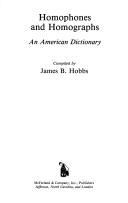 Homophones and homographsJames B. Hobbs · 1986
Ranked by number of editions on Open Library, a rough measure of how lasting a book is.
🔗 Related topics
- Homonym In linguistics, homonyms are words that are either homographs, words that mean different things but have the same spelling (regardless of pronunciation);…
- Heteronym (linguistics) This article contains phonetic transcriptions in the International Phonetic Alphabet (IPA). For an introductory guide on IPA symbols, see Help:IPA. For…
- Heteronym Look up heteronym in Wiktionary, the free dictionary. Heteronym may refer to: Heteronym (linguistics), one of a group of words with identical spellings…
- List of English homographs Homographs are words with the same spelling but having more than one meaning. Homographs may be pronounced the same (homophones), or they may be pronounced…
- Homophone A homophone (/ˈhɒməfoʊn, ˈhoʊmə-/) is a word that is pronounced the same as another word but differs in meaning or in spelling. The two words may be spelled…
- Interlingual homograph An interlingual homograph is a word that occurs in more than one written language, but which has a different meaning or pronunciation in each language…
- Initial-stress-derived noun Initial-stress derivation is a phonological process in English that moves stress to the first syllable of verbs when they are used as nouns or adjectives…
- Synonym A synonym is a word, morpheme, or phrase that has a similar or identical meaning to another word, morpheme, or phrase in a given language. For example…