Everything about Homogeneous catalysis
Chemical reaction where catalyst and reactants are in the same phase of matter
In chemistry, homogeneous catalysis is catalysis where the catalyst is in same phase as reactants, principally by a soluble catalyst in a solution. In contrast, heterogeneous catalysis describes processes where the catalysts and substrate are in distinct phases, typically solid and gas, respectively. The term is used almost exclusively to describe solutions and implies catalysis by organometallic compounds. Homogeneous catalysis is an established technology that continues to evolve. An illustrative major application is the production of acetic acid. Enzymes are examples of homogeneous catalysts. Wikipedia →
🧭 Start here: a 6-step reading path
- Read the overview: Homogeneous catalysisA 5-minute orientation
- Skim a recent paper: Recent Applications of Homogeneous Catalysis in Electrochemical Organic SynthesisInfluential work since 2022
- Pick up a classic book: Bimodal OxidationThe most-reprinted book on the subject
- Read the landmark paper: Steric effects of phosphorus ligands in organometallic chemistry and homogeneous catalysisCited 4,584 times
- Go sideways: Organometallic chemistryA closely related topic
- Go sideways: Organorhodium chemistryA closely related topic
📖 Definitions
Noun (chemistry) Catalysis in which the catalyst is present in the same phase as the reactants; normally dissolved in the same solvent.
🗂️ The subject at a glance
🏆 Landmark papers (most cited)
Steric effects of phosphorus ligands in organometallic chemistry and homogeneous catalysis
Nanoparticles as Recyclable Catalysts: The Frontier between Homogeneous and Heterogeneous Catalysis
Atom Economy—A Challenge for Organic Synthesis: Homogeneous Catalysis Leads the Way
Recent advances in homogeneous nickel catalysis
🆕 Influential since 2022
Recent Applications of Homogeneous Catalysis in Electrochemical Organic Synthesis
Designing Sites in Heterogeneous Catalysis: Are We Reaching Selectivities Competitive With Those of Homogeneous Catalysts?
Synergy between homogeneous and heterogeneous catalysis
General cross-coupling reactions with adaptive dynamic homogeneous catalysis
Chemical recycling of plastic wastes via homogeneous catalysis: A review
📚 Books worth reading
- 📕Bimodal OxidationRobert Bakhtchadjian · 2019
 Applications of EPR and NMR Spectroscopy in Homogeneous CatalysisEvgenii P. Talsi, Konstantin Bryliakov · 2017
 Homogeneous catalysisP. W. N. M. van Leeuwen · 2004
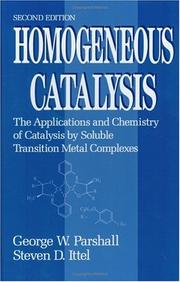 Homogeneous catalysisGeorge William Parshall · 1980
 Industrial applications of homogeneous catalysisFrancis Petit · 1987
 Homogeneous catalysis--IIJames Frank Roth · 1974
 Transition Metal Catalyzed Enantioselective Allylic Substitution in Organic SynthesisUli Kazmaier · 2012
 Heterogeneous catalysis in organic chemistryGerard V. Smith · 1999
Ranked by number of editions on Open Library, a rough measure of how lasting a book is.
🔗 Related topics
- Organometallic chemistry Organometallic chemistry is the study of organometallic compounds, chemical compounds containing at least one chemical bond between a carbon atom of an…
- Organorhodium chemistry Organorhodium chemistry is the chemistry of organometallic compounds containing a rhodium-carbon chemical bond, and the study of rhodium and rhodium compounds…
- TPPTS 3,3′,3′′-Phosphanetriyltris(benzenesulfonic acid) trisodium salt (abbreviated TPPTS), is an organic compound that is also known as sodium triphenylphosphine…
- Hydroformylation In organic chemistry, hydroformylation, also known as oxo synthesis or oxo process, is an industrial process for the production of aldehydes (R−CH=O) from…
- Migratory insertion In organometallic chemistry, a migratory insertion is a type of reaction wherein two ligands on a metal complex combine. It is a subset of reactions that…
- Hydrogenation Hydrogenation is a chemical reaction between molecular hydrogen (H2) and another compound or element, usually in the presence of a catalyst such as nickel…
- Clark R. Landis Clark Landis (born 1956) is an American chemist, whose research focuses on organic and inorganic chemistry. He is currently a Professor of Chemistry at…
- Catalysis Catalysis (/kəˈtælɪsɪs/, kə-TAL-iss-iss) is the increase in rate of a chemical reaction due to an added substance known as a catalyst (/ˈkætəlɪst/ KAT-əl-ist)…