Live briefing
Everything about Handle (computing)
Abstract reference to a system resource in computing
In computer programming, a handle is an abstract reference to a resource that is used when application software references blocks of memory or objects that are managed by another system like a database or an operating system. Wikipedia →
🧭 Start here: a 6-step reading path
- Read the overview: Handle (computing)A 5-minute orientation
- Skim a recent paper: Risk management strategy for generative AI in computing education: how to handle the strengths, weaknesses, opportunities, and threats?Influential work since 2022
- Pick up a classic book: Proceedings of Manufacturing International '90The most-reprinted book on the subject
- Read the landmark paper: Computing geometry-aware handle and tunnel loops in 3D modelsCited 61 times
- Go sideways: Capability-based securityA closely related topic
- Go sideways: File descriptorA closely related topic
📖 Definitions
No dictionary entry for this exact phrase.
🗂️ The subject at a glance
🏆 Landmark papers (most cited)
Computing geometry-aware handle and tunnel loops in 3D models
Cloud computing for big data analytics How cloud computing can handle procesing large amounts of data and improve real-time data analytics
Computing handle and tunnel loops with knot linking
IoT-based health monitoring system to handle pandemic diseases using estimated computing
A Hierarchical Hadoop Framework to Handle Big Data in Geo-Distributed Computing Environments
Use of high accuracy schemes to handle free surfaces in computing unsteady two-phase flows
Computing and Estimating Distortion Risk Measures: How to Handle Analytically Intractable Cases?
Computing skeleton-based handle/tunnel loops
🆕 Influential since 2022
Risk management strategy for generative AI in computing education: how to handle the strengths, weaknesses, opportunities, and threats?
Pod Allocation Algorithms to Handle Time-Varying Numbers of Applications Occurrence on the Access-Metro Edge Computing
Fog Computing Platform to Handle Internet of Things Data Heterogeneity
📚 Books worth reading
 Proceedings of Manufacturing International '90Manufacturing International '90 (1990 Atlanta, Ga.) · 1990
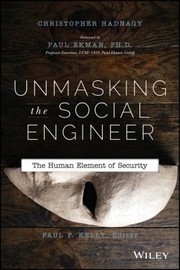 Unmasking The Social Engineer The Human Element Of SecurityChristopher Hadnagy, Paul F. Kelly · 2014
 Materials handling for the printerA. John Geis, Paul L. Addy · 1993
 BlurStanley M. Davis, Stan Davis · 1998
 Shiphandling SimulationNational Research Council (US) · 1992
 Machine LandscapesLiam Young · 2019
 Development of a real-time hybrid computer simulation for the 3K-SES, 5 DOF, data-based programAlex Gerba · 1979
- 📕Experimental test concept for a cargo data interchange system (CARDIS)C. Ruthling · 1976
Ranked by number of editions on Open Library, a rough measure of how lasting a book is.
🔗 Related topics
- Capability-based security Capability-based security is a concept in the design of secure computing systems, one of the existing security models. A capability (known in some systems…
- File descriptor In Unix and Unix-like computer operating systems, a file descriptor (FD, less frequently fildes) is a process-unique identifier (handle) for a file or…
- Zombie process On Unix and Unix-like computer operating systems, a zombie process or defunct process is a process that has completed execution (via the exit system call)…
- Inode An inode (index node) is a data structure in a Unix-style file system that describes a file-system object such as a file or a directory. Each inode stores…
- Process control block A process control block (PCB), also sometimes called a process descriptor, is a data structure used by a computer operating system to store all the information…
- Object Manager Object Manager (internally called Ob) is a subsystem implemented as part of the Windows Executive which manages Windows resources. Resources, which are…
- Open (system call) In Unix-like operating systems, a program initializes access to a file in a file system using the open system call. This allocates resources associated…
- Dispose pattern In object-oriented programming, the dispose pattern is a design pattern for resource management. In this pattern, a resource is held by an object, and…