Everything about Hadamard code
Error-correcting code

The Hadamard code is an error-correcting code named after the French mathematician Jacques Hadamard that is used for error detection and correction when transmitting messages over very noisy or unreliable channels. In 1971, the code was used to transmit photos of Mars back to Earth from the NASA space probe Mariner 9. Because of its unique mathematical properties, the Hadamard code is not only used by engineers, but also intensely studied in coding theory, mathematics, and theoretical computer science. The Hadamard code is also known under the names Walsh code, Walsh family, and Walsh–Hadamard code in recognition of the American mathematician Joseph Leonard Walsh. Wikipedia →
🧭 Start here: a 6-step reading path
- Read the overview: Hadamard codeA 5-minute orientation
- Skim a recent paper: Performance Enhancement for m-Sequence and Hadamard Code SAC-OCDMA Systems Based on Narrowband FiltersInfluential work since 2022
- Pick up a classic book: Hadamard matrix analysis and synthesisThe most-reprinted book on the subject
- Read the landmark paper: Cocyclic Hadamard codesCited 33 times
- Go sideways: Locally decodable codeA closely related topic
- Go sideways: Locally testable codeA closely related topic
📖 Definitions
No dictionary entry for this exact phrase.
🗂️ The subject at a glance
🏆 Landmark papers (most cited)
Cocyclic Hadamard codes
Generation of Hadamard matrices for phase-code-multiplexed holographic memories
Full-Optical TOAD based Walsh-Hadamard code generation
The Bank of Matched Filters for an Optical ZCZ Code Using a Sylvester Type Hadamard Matrix
Spectral Sidelobe Decaying Property of Walsh-Hadamard Code in MC-CDMA Systems
Low-overhead surface code logical Hadamard
LDPC-Hadamard Code-Assisted OTFS in High-Mobility Scenarios
Efficient Low-Complexity Turbo-Hadamard Code in UAV Anti-Jamming Communications
🆕 Influential since 2022
Performance Enhancement for m-Sequence and Hadamard Code SAC-OCDMA Systems Based on Narrowband Filters
Hadamard code based numerical mapping approach for the identification of protein coding regions in genomic sequences using digital filters
TS-WHT: A Two-Step Walsh–Hadamard Transform Approach for Blind Error Correcting Code Classification
Simulating the Hadamard gate in the Fibonacci disk code for universal topological quantum computation
Hadamard square of linear codes and the generalized minimal distance of Reed–Muller code of order 2
📚 Books worth reading
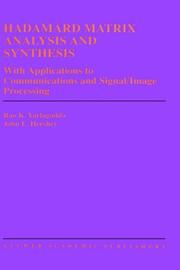 Hadamard matrix analysis and synthesisR. K. Rao Yarlagadda, Rao K. Yarlagadda · 1996
Ranked by number of editions on Open Library, a rough measure of how lasting a book is.
🔗 Related topics
- Locally decodable code A locally decodable code (LDC) is an error-correcting code that allows a single bit of the original message to be decoded with high probability by only…
- Locally testable code A locally testable code is a type of error-correcting code for which it can be determined if a string is a word in that code by looking at a small (frequently…
- Block code In coding theory, block codes are a large and important family of error-correcting codes that encode data in blocks. There is a vast number of examples…
- Reed–Muller code Reed–Muller codes are error-correcting codes that are used in wireless communications applications, particularly in deep-space communication. In cryptography…
- Linear code In coding theory, a linear code is an error-correcting code for which any linear combination of codewords is also a codeword. Linear codes are traditionally…
- Hamming code In computer science and telecommunications, Hamming codes are a family of linear error-correcting codes. Hamming codes can detect one-bit and two-bit errors…
- Gilbert–Varshamov bound for linear codes The Gilbert–Varshamov bound for linear codes is related to the general Gilbert–Varshamov bound, which gives a lower bound on the maximal number of elements…
- Decoding methods In coding theory, decoding is the process of translating received messages into codewords of a given code. There have been many common methods of mapping…