Everything about Block code
Family of error-correcting codes that encode data in blocks
In coding theory, block codes are a large and important family of error-correcting codes that encode data in blocks. There is a vast number of examples for block codes, many of which have a wide range of practical applications. The abstract definition of block codes is conceptually useful because it allows coding theorists, mathematicians, and computer scientists to study the limitations of all block codes in a unified way. Such limitations often take the form of bounds that relate different parameters of the block code to each other, such as its rate and its ability to detect and correct errors. Wikipedia →
🧭 Start here: a 6-step reading path
- Read the overview: Block codeA 5-minute orientation
- Skim a recent paper: Multiple-Mode Sparse Superposed Code With Low Block Error Rate for Short Packet URLLCInfluential work since 2022
- Pick up a classic book: Assembly language programming for the TRS-80 Model 16The most-reprinted book on the subject
- Read the landmark paper: Space-time block codes from orthogonal designsCited 5,327 times
- Go sideways: Hamming boundA closely related topic
- Go sideways: List decodingA closely related topic
📖 Definitions
Noun A type of error-correcting code that encodes messages divided into fixed-sized blocks to codewords with a specific length.
🏆 Landmark papers (most cited)
Space-time block codes from orthogonal designs
Iterative decoding of binary block and convolutional codes
A quasi-orthogonal space-time block code
A DC-Balanced, Partitioned-Block, 8B/10B Transmission Code
Chip-interleaved block-spread code division multiple access
Surface code implementation of block code state distillation
Hierarchical Space-Time Block Code Recognition Using Correlation Matrices
Equalization Concepts for Alamouti's Space–Time Block Code
🆕 Influential since 2022
Multiple-Mode Sparse Superposed Code With Low Block Error Rate for Short Packet URLLC
Neural Belief Propagation Auto-Encoder for Linear Block Code Design
The effect of embedded structures on cognitive load for novice learners during block-based code comprehension
Enhanced CQI to Boost the Performance of 5G-Advanced XR With Code Block Group Transmissions
IoTSim: Internet of Things-Oriented Binary Code Similarity Detection with Multiple Block Relations
📚 Books worth reading
 Assembly language programming for the TRS-80 Model 16Dan Keen, Dave Dischert · 1984
 Ordering Block Designs Gray Codes Universal Cycles And Configuration OrderingsBrett Stevens · 2012
- 📕L P B L K DAndré F. Perold · 1979
 Quasi-symmetric designsMohan S. Shrikhande · 1991
 Graphs, codes, and designsPeter J. Cameron · 1980
 Graph theory, coding theory, and block designsPeter J. Cameron · 1975
 Grouping census block and tract numbers for GNRP areas: 1960 · 1962
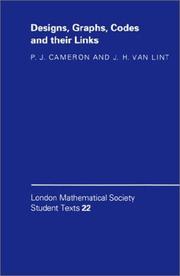 Designs, graphs, codes, and their linksPeter J. Cameron · 1991
Ranked by number of editions on Open Library, a rough measure of how lasting a book is.
🔗 Related topics
- Hamming bound In mathematics and computer science, in the field of coding theory, the Hamming bound is a limit on the parameters of an arbitrary block code: it is also…
- List decoding In coding theory, list decoding is an alternative to unique decoding of error-correcting codes for large error rates. The notion was proposed by Elias…
- Hadamard code The Hadamard code is an error-correcting code named after the French mathematician Jacques Hadamard that is used for error detection and correction when…
- Linear code In coding theory, a linear code is an error-correcting code for which any linear combination of codewords is also a codeword. Linear codes are traditionally…
- Locally decodable code A locally decodable code (LDC) is an error-correcting code that allows a single bit of the original message to be decoded with high probability by only…
- Gilbert–Varshamov bound for linear codes The Gilbert–Varshamov bound for linear codes is related to the general Gilbert–Varshamov bound, which gives a lower bound on the maximal number of elements…
- Concatenated error correction code In coding theory, concatenated codes form a class of error-correcting codes that are derived by combining an inner code and an outer code. They were conceived…
- Reed–Solomon error correction In information theory and coding theory, Reed–Solomon codes are a group of error-correcting codes that were introduced by Irving S. Reed and Gustave Solomon…