Live briefing
Everything about Fair queuing
Scheduling algorithm for sharing of limited resources
Fair queuing is a family of scheduling algorithms used in some process and network schedulers. The algorithm is designed to achieve fairness when a limited resource is shared, for example to prevent flows with large packets or processes that generate small jobs from consuming more throughput or CPU time than other flows or processes. Wikipedia →
🧭 Start here: a 6-step reading path
- Read the overview: Fair queuingA 5-minute orientation
- Skim a recent paper: Scalable Flow Isolation With Work Conserving Stateless Core Fair Queuing for Deterministic NetworkingInfluential work since 2022
- Pick up a classic book: Computer networkingThe most-reprinted book on the subject
- Read the landmark paper: Efficient fair queuing using deficit round-robinCited 991 times
- Go sideways: Weighted fair queueingA closely related topic
- Go sideways: Generalized processor sharingA closely related topic
📖 Definitions
No dictionary entry for this exact phrase.
🗂️ The subject at a glance
🏆 Landmark papers (most cited)
Efficient fair queuing using deficit round-robin
Fair queuing in wireless networks: issues and approaches
How fair is fair queuing
A Fair Comparison of Message Queuing Systems
Hardware implementation of fair queuing algorithms for asynchronous transfer mode networks
Fair Queuing and Other Probabilistic Allocation Methods
Adaptive Fair Subcarrier/Rate Allocation in Multirate OFDMA Networks: Radio Link Level Queuing Performance Analysis
Energy efficient wireless packet scheduling and fair queuing
🆕 Influential since 2022
Scalable Flow Isolation With Work Conserving Stateless Core Fair Queuing for Deterministic Networking
Performance Analysis of Weighted Fair Queuing (WFQ) Scheduler Algorithm through Efficient Resource Allocation in Network Traffic Modeling
Ares: Fair and Efficient Scheduling of Deep Learning Jobs with Elastic Fair Queuing
Optimizing Weighted Fair Queuing with Deep Reinforcement Learning for Dynamic Bandwidth Allocation
Fair assignment of urban–rural electric vehicle shared charging using queuing theory
📚 Books worth reading
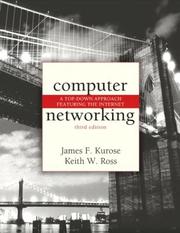 Computer networkingJames F. Kurose, Keith W. Ross · 1900
- 📕Optimizing emergency department throughputJohn M. Shiver · 2010
- 📕Next-generation internetByrav Ramamurthy · 2010
 Design and analysis of wireless networksXiao, Yang · 2004
- 📕A distributed fair queuing MAC scheduler for wireless ATM networkWing-Chung Hung · 1999
- 📕Performance modeling and design of computer systemsMor Harchol-Balter · 2013
 Stochastic network optimization with application to communication and queueing systemsMichael J. Neely · 2010
 Next-generation internetByrav Ramamurthy · 2011
Ranked by number of editions on Open Library, a rough measure of how lasting a book is.
🔗 Related topics
- Weighted fair queueing Weighted fair queueing (WFQ) is a network scheduling algorithm. WFQ is both a packet-based implementation of the generalized processor sharing (GPS) policy…
- Generalized processor sharing Generalized processor sharing (GPS) is an ideal scheduling algorithm for process schedulers and network schedulers. It is related to the fair-queuing principle…
- Round-robin scheduling Round-robin (RR) is one of the algorithms employed by process and network schedulers in computing. As the term is generally used, time slices (also known…
- Enhanced Transmission Selection Enhanced Transmission Selection (ETS) is a network scheduler scheduling algorithm that has been defined by the Data Center Bridging Task Group of the IEEE…
- Weighted round robin Weighted round robin (WRR) is a network scheduler for data flows, but also used to schedule processes. Weighted round robin is a generalisation of round-robin…
- Input queue In computer science, an input queue is a collection of processes in storage that are waiting to be brought into memory to run a program. Input queues are…
- Deficit round robin Deficit round robin (DRR), also deficit-weighted round robin (DWRR), is a scheduling algorithm for the network scheduler. DRR is, similar to weighted fair…
- Proportional-fair scheduling Proportional-fair scheduling is a compromise-based scheduling algorithm. It is based upon maintaining a balance between two competing interests: Trying…