Live briefing
Everything about Binary Goppa code
Kind of error correction code
In mathematics and computer science, the binary Goppa code is an error-correcting code that belongs to the class of general Goppa codes originally described by Valerii Denisovich Goppa, but the binary structure gives it several mathematical advantages over non-binary variants, also providing a better fit for common usage in computers and telecommunication. Binary Goppa codes have interesting properties suitable for cryptography in McEliece-like cryptosystems and similar setups. Wikipedia →
🧭 Start here: a 6-step reading path
- Read the overview: Binary Goppa codeA 5-minute orientation
- Skim a recent paper: Enumeration of Extended Irreducible Binary Goppa CodesInfluential work since 2022
- Pick up a classic book: Advances in coding theory and crytographyThe most-reprinted book on the subject
- Read the landmark paper: The weights of the orthogonals of the extended quadratic binary Goppa codesCited 217 times
- Go sideways: Guruswami–Sudan list decoding algorithmA closely related topic
- Go sideways: Linear codeA closely related topic
📖 Definitions
No dictionary entry for this exact phrase.
🗂️ The subject at a glance
🏆 Landmark papers (most cited)
The weights of the orthogonals of the extended quadratic binary Goppa codes
Further results on Goppa codes and their applications to constructing efficient binary codes
Extended double-error-correcting binary Goppa codes are cyclic (Corresp.)
Subclass of binary Goppa codes with minimal distance equal to the design distance
A [55,16,19] binary Goppa code (Corresp.)
Symmetries of binary Goppa codes (Corresp.)
The true dimension of certain binary Goppa codes
Optimized and Scalable Co-Processor for McEliece with Binary Goppa Codes
🆕 Influential since 2022
Enumeration of Extended Irreducible Binary Goppa Codes
Extended Irreducible Binary Sextic Goppa Codes
Non-binary irreducible quasi-cyclic parity-check subcodes of Goppa codes and extended Goppa codes
The Number of Extended Irreducible Binary Goppa Codes
Upper bound on the number of inequivalent extended binary irreducible Goppa codes
📚 Books worth reading
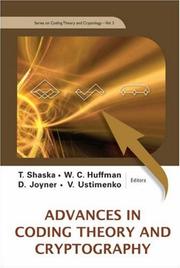 Advances in coding theory and crytographyTanush Shaska, W. Cary Huffman · 2007
- 📕Groups, algebras and applicationsLatin American Algebra Colloquium (18th 2009 São Pedro, São Paulo, Brazil) · 2011
Ranked by number of editions on Open Library, a rough measure of how lasting a book is.
🔗 Related topics
- Guruswami–Sudan list decoding algorithm In coding theory, list decoding is an alternative to unique decoding of error-correcting codes in the presence of many errors. If a code has relative distance…
- Linear code In coding theory, a linear code is an error-correcting code for which any linear combination of codewords is also a codeword. Linear codes are traditionally…
- Hadamard code The Hadamard code is an error-correcting code named after the French mathematician Jacques Hadamard that is used for error detection and correction when…
- Mathematics of cyclic redundancy checks The cyclic redundancy check (CRC) is a check of the remainder after division in the ring of polynomials over GF(2) (the finite field of integers modulo…
- AN codes AN codes are error-correcting code that are used in arithmetic applications. Arithmetic codes were commonly used in computer processors to ensure the accuracy…
- McEliece cryptosystem In cryptography, the McEliece cryptosystem is an asymmetric encryption algorithm developed in 1978 by Robert McEliece. It was the first such scheme to…
- Niederreiter cryptosystem In cryptography, the Niederreiter cryptosystem is a variation of the McEliece cryptosystem developed in 1986 by Harald Niederreiter. It applies the same…
- Decoding methods In coding theory, decoding is the process of translating received messages into codewords of a given code. There have been many common methods of mapping…