Everything about Bayesian statistics
Theory and paradigm of statistics
Bayesian statistics is a theory in the field of statistics based on the Bayesian interpretation of probability, where probability expresses a degree of belief in an event. The degree of belief may be based on prior knowledge about the event, such as the results of previous experiments, or on personal beliefs about the event. This differs from a number of other interpretations of probability, such as the frequentist interpretation, which views probability as the limit of the relative frequency of an event after many trials. More concretely, analysis in Bayesian methods codifies prior knowledge in the form of a prior distribution. Wikipedia →
🧭 Start here: a 6-step reading path
- Read the overview: Bayesian statisticsA 5-minute orientation
- Skim a recent paper: Bayesian statistics for clinical researchInfluential work since 2022
- Pick up a classic book: The advanced theory of statisticsThe most-reprinted book on the subject
- Read the landmark paper: Bayesian statistics and modellingCited 1,126 times
- Go sideways: Bayesian econometricsA closely related topic
- Go sideways: Bayesian hierarchical modelingA closely related topic
📖 Definitions
No dictionary entry for this exact phrase.
🗂️ The subject at a glance
🏆 Landmark papers (most cited)
Bayesian statistics and modelling
Bayesian Statistics and Marketing
Bayesian statistics for parasitologists
Bayesian statistics in oncology
Bayesian statistics
Bayesian Statistics in Archaeology
Bayesian statistics
Bayesian statistics and modelling
🆕 Influential since 2022
Bayesian statistics for clinical research
Understanding the Differences Between Bayesian and Frequentist Statistics
Bayesian Image Super-Resolution With Deep Modeling of Image Statistics
Convolutional Neural Networks as Summary Statistics for Approximate Bayesian Computation
Statistics-based Bayesian modeling framework for uncertainty quantification and propagation
📚 Books worth reading
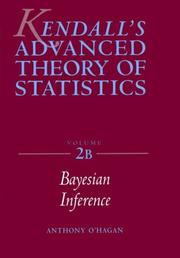 The advanced theory of statisticsMaurice G. Kendall, Maurice Kendall · 1943
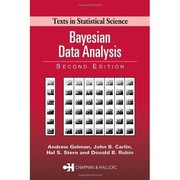 Bayesian data analysisAndrew Gelman, John B. Carlin · 1995
 Introduction to probability modelsSheldon M. Ross · 1972
 Statistical RethinkingRichard McElreath · 2015
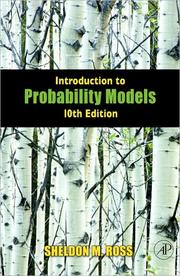 Introduction to probability modelsSheldon M. Ross · 1972
 Bayesian NetworksMarco Scutari, Jean-Baptiste Denis · 2014
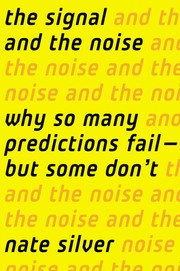 The Signal and the NoiseNate Silver · 2012
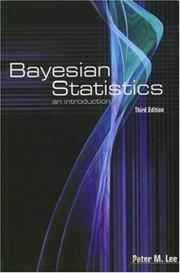 Bayesian statisticsPeter M. Lee · 1989
Ranked by number of editions on Open Library, a rough measure of how lasting a book is.
🔗 Related topics
- Bayesian econometrics Bayesian econometrics is a branch of econometrics which applies Bayesian principles to economic modelling. Bayesianism is based on a degree-of-belief interpreta…
- Bayesian hierarchical modeling Bayesian hierarchical modelling is a statistical model written in multiple levels (hierarchical form) that estimates the posterior distribution of model…
- Bernstein–von Mises theorem In Bayesian inference, the Bernstein–von Mises theorem provides the basis for using Bayesian credible sets for confidence statements in parametric models…
- Parametric statistics Parametric statistics is a branch of statistics that is concerned with the analysis of and inference from data assuming that the underlying distribution…
- Laplace's approximation Laplace's approximation or the quadratic approximation (QUAP) provides an analytical expression for a posterior probability distribution by fitting a Gaussian…
- Gibbs sampling In statistics, Gibbs sampling or a Gibbs sampler, also known in statistical mechanics as the heat bath algorithm, is a Markov chain Monte Carlo (MCMC)…
- Admissible decision rule In statistical decision theory, an admissible decision rule is a rule for making a decision such that there is no other rule that is always "better" than…
- Marginal likelihood A marginal likelihood is a likelihood function that has been integrated over the parameter space. In Bayesian statistics, it represents the probability…