Everything about Assembly language
Low-level programming language family

In computing, assembly language, often referred to simply as assembly and commonly abbreviated as ASM or asm, is any low-level programming language with a very strong correspondence between the instructions in the language and the architecture's machine code instructions. Assembly language usually has one statement per machine code instruction (1:1), but constants, comments, assembler directives, symbolic labels of, e.g., memory locations, registers, and macros are generally also supported. Wikipedia →
🧭 Start here: a 6-step reading path
- Read the overview: Assembly languageA 5-minute orientation
- Skim a recent paper: OpenQASM 3: A Broader and Deeper Quantum Assembly LanguageInfluential work since 2022
- Pick up a classic book: ARM Assembly languageThe most-reprinted book on the subject
- Read the landmark paper: From system F to typed assembly languageCited 374 times
- Go sideways: X86 assembly languageA closely related topic
- Go sideways: OpcodeA closely related topic
📖 Definitions
Noun A programming language in which the source code of programs is composed of mnemonic instructions, each of which corresponds directly to a machine instruction for a particular processor.
🗂️ The subject at a glance
🏆 Landmark papers (most cited)
From system F to typed assembly language
A cell assembly model of language
Stack-based typed assembly language
The case for assembly language programming
A cell assembly model of language
Heap-Bounded Assembly Language
Aladdin: Assembly Language Assertion Driven Debugging Interpreter
Special Feature: Microprocessor Assembly Language Draft Standard
🆕 Influential since 2022
OpenQASM 3: A Broader and Deeper Quantum Assembly Language
Assessment of a large language model based digital intelligent assistant in assembly manufacturing
Learning the rules of peptide self-assembly through data mining with large language models
VLM-MSGraph: Vision Language Model-enabled Multi-hierarchical Scene Graph for robotic assembly
Zero day ransomware detection with Pulse: Function classification with Transformer models and assembly language
📚 Books worth reading
 ARM Assembly languageWilliam Hohl · 2009
 Assembly Language Step-by-stepJeff Duntemann · 2000
 Assembly language programmingVincent Mahout · 2012
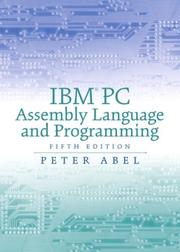 IBM PC assembly language and programmingAbel, Peter · 1991
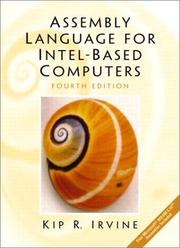 Assembly language for Intel-based computersKip R. Irvine · 1999
 The art of Assembly languageRandall Hyde · 2003
 Assembly language for the IBM PC familyWilliam B. Jones, William B. Jones · 1992
- 📕MIXDonald Knuth · 1970
Ranked by number of editions on Open Library, a rough measure of how lasting a book is.
🔗 Related topics
- X86 assembly language x86 assembly language is a family of low-level programming languages that are used to produce object code for the x86 class of processors. Previous evolutions…
- Opcode In computing, an opcode (abbreviated from operation code) is an enumerated value that specifies the operation to be performed. Opcodes are employed in…
- Halt and Catch Fire (computing) In computer engineering, Halt and Catch Fire, known by the assembly language mnemonic HCF, is an idiom referring to a computer machine code instruction…
- Low-level programming language A low-level programming language is a programming language that provides little or no abstraction from a computer's instruction set architecture, memory…
- IBM Basic assembly language and successors The IBM Basic assembly language and successors is a series of assembly languages and assemblers made for the IBM System/360 mainframe system and its successors…
- Machine code In computing, machine code is data encoded and structured to control a computer's central processing unit (CPU) via its programmable interface. A computer…
- List of discontinued x86 instructions Instructions that have at some point been present as documented instructions in one or more x86 processors, but where the processor series containing the…
- List of x86 instructions The x86 instruction set refers to the set of instructions that x86-compatible microprocessors support. The instructions are usually part of an executable…