Live briefing

Everything about XML
Markup language and file format
Extensible Markup Language (XML) is a markup language and file format for storing, transmitting, and reconstructing data. It defines a set of rules for encoding documents in a format that is both human-readable and machine-readable. The World Wide Web Consortium's XML 1.0 Specification of 1998 and several other related specifications—all of them free open standards—define XML. Wikipedia →
🧭 Start here: a 6-step reading path
- Read the overview: XMLA 5-minute orientation
- Skim a recent paper: Explainable Machine Learning (XML) to predict external wind pressure of a low-rise building in urban-like settingsInfluential work since 2022
- Pick up a classic book: XML in a nutshellThe most-reprinted book on the subject
- Read the landmark paper: A uniform proteomics MS/MS analysis platform utilizing open XML file formatsCited 605 times
- Go sideways: Document type definitionA closely related topic
- Go sideways: Standard Generalized Markup LanguageA closely related topic
📖 Definitions
Symbol ISO 639-3 language code for Malaysian Sign Language.
🏆 Landmark papers (most cited)
A uniform proteomics MS/MS analysis platform utilizing open XML file formats
phyloXML: XML for evolutionary biology and comparative genomics
The Semantic Web: the roles of XML and RDF
SAWSDL: Semantic Annotations for WSDL and XML Schema
A fine-grained access control system for XML documents
Generation of Projector Augmented-Wave atomic data: A 71 element validated table in the XML format
The Open Microscopy Environment (OME) Data Model and XML file: open tools for informatics and quantitative analysis in biological imaging
Path sharing and predicate evaluation for high-performance XML filtering
🆕 Influential since 2022
Explainable Machine Learning (XML) to predict external wind pressure of a low-rise building in urban-like settings
Explainable machine learning (XML) framework for seismic assessment of structures using Extreme Gradient Boosting (XGBoost)
XML-GBM lung: An explainable machine learning-based application for the diagnosis of lung cancer
XML-CIMT: Explainable Machine Learning (XML) Model for Predicting Chemical-Induced Mitochondrial Toxicity
Shear capacity of FRP-RC beams: XML modeling and reliability evaluation
📚 Books worth reading
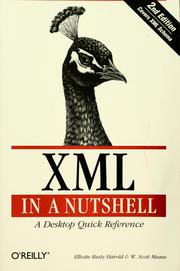 XML in a nutshellElliotte Rusty Harold, W. Scott Means · 2001
 Definitive XML SchemaPriscilla Walmsley · 2001
 Beginning XMLDavid Hunter, Kurt Cagle · 2001
 Mobile computing principlesReza B'Far · 2000
 DocBookNorman Walsh · 1999
 XML for dummiesLucinda Dykes · 2005
 Learning XMLErik T. Ray · 2001
 Perl & XMLErik Ray, Jason McIntosh · 2002
Ranked by number of editions on Open Library, a rough measure of how lasting a book is.
🔗 Related topics
- Document type definition A document type definition (DTD) is a specification file that contains a set of markup declarations that define a document type for an SGML-family markup…
- Standard Generalized Markup Language The Standard Generalized Markup Language (SGML; ISO 8879:1986) is a standard for defining generalized markup languages for documents. ISO 8879 Annex A…
- XML schema An XML schema is a description of a type of XML document, typically expressed in terms of constraints on the structure and content of documents of that…
- List of XML and HTML character entity references In SGML, HTML and XML documents, the logical constructs known as character data and attribute values consist of sequences of characters, in which each…
- XHTML Extensible HyperText Markup Language (XHTML) is part of the family of XML markup languages which mirrors or extends versions of the widely used HyperText…
- Document type declaration A document type declaration, or DOCTYPE, is an instruction that associates a particular XML or SGML document (for example, a web page) with a document…
- Formal Public Identifier A Formal Public Identifier (FPI) is a short piece of text with a particular structure that may be used to uniquely identify a product, specification or…
- W3C Markup Validation Service The Markup Validation Service is a validator by the World Wide Web Consortium (W3C) that allows Internet users to check pre-HTML5 HTML and XHTML documents…