Everything about Wireless security
Aspect of wireless networks

Wireless security is the prevention of unauthorized access or damage to computers or data using Wireless networks, which include Wi-Fi networks. The term may also refer to protecting the wireless network itself from adversaries seeking to damage the confidentiality, integrity, or availability of the network. The most common type is Wi-Fi security, which includes Wired Equivalent Privacy (WEP) and Wi-Fi Protected Access (WPA). WEP is an old IEEE 802.11 standard from 1997. It is a notoriously weak security standard: the password it uses can often be cracked in a few minutes with a basic laptop computer and widely available software tools. WEP was superseded in 2003 by WPA, a quick alternative at the time to improve security over WEP. The current standard is WPA2; some hardware cannot support WPA2 without a firmware upgrade or replacement. WPA2 uses an encryption device that encrypts the network with a 256-bit key; the longer key length improves security over WEP. Enterprises often enforce security using a certificate-based system to authenticate the connecting device, following the standard 802.11X. Wikipedia →
🧭 Start here: a 6-step reading path
- Read the overview: Wireless securityA 5-minute orientation
- Skim a recent paper: Toward Multi-Functional 6G Wireless Networks: Integrating Sensing, Communication, and SecurityInfluential work since 2022
- Pick up a classic book: Wireless Mobile Internet SecurityThe most-reprinted book on the subject
- Read the landmark paper: Wireless Information-Theoretic SecurityCited 1,640 times
- Go sideways: Wi-Fi Protected AccessA closely related topic
- Go sideways: IEEE 802.11i-2004A closely related topic
📖 Definitions
No dictionary entry for this exact phrase.
🏆 Landmark papers (most cited)
Wireless Information-Theoretic Security
Security in wireless sensor networks
Wireless physical layer security
Security in wireless sensor networks
Security in Wireless Communication
Survey on Wireless Network Security
Wireless security is different
Security in wireless residential networks
🆕 Influential since 2022
Toward Multi-Functional 6G Wireless Networks: Integrating Sensing, Communication, and Security
Wireless communications sensing and security above 100 GHz
Context-Aware Security for 6G Wireless: The Role of Physical Layer Security
Cryptographic Data Security for Reliable Wireless Sensor Network
The Security in Optical Wireless Communication: A Survey
📚 Books worth reading
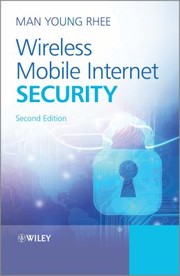 Wireless Mobile Internet SecurityMan Young Rhee · 2013
 The Art of InvisibilityKevin D. Mitnick, Robert Vamosi · 2017
 Hacking Wireless Networks for DummiesKevin Beaver · 2005
- 📕Security for wireless sensor networks using identity-based cryptographyHarsh Kupwade Patil · 2012
 Wireless HacksRob Flickenger, Roger Weeks · 2003
 Wireless Internet securityJames Kempf · 2008
- 📕Information securityUnited States. Government Accountability Office · 2010
- 📕Location Privacy in Wireless Sensor NetworksRuben Rios, Javier Lopez · 2016
Ranked by number of editions on Open Library, a rough measure of how lasting a book is.
🔗 Related topics
- Wi-Fi Protected Access Wi-Fi Protected Access (WPA), Wi-Fi Protected Access 2 (WPA2), and Wi-Fi Protected Access 3 (WPA3) are the three security certification programs developed…
- IEEE 802.11i-2004 IEEE 802.11i-2004, or 802.11i for short, is an amendment to the original IEEE 802.11, implemented as Wi-Fi Protected Access II (WPA2). The draft standard…
- Aircrack-ng Aircrack-ng is a network software suite consisting of a detector, packet sniffer, WEP and WPA/WPA2-PSK cracker and analysis tool for 802.11 wireless LANs…
- Wired Equivalent Privacy Wired Equivalent Privacy (WEP) is an obsolete security algorithm for 802.11 wireless networks. It was introduced as part of the original IEEE 802.11 standard…
- Wpa supplicant wpa_supplicant is a free software implementation of an IEEE 802.11i supplicant for Linux, FreeBSD, NetBSD, QNX, AROS, Microsoft Windows, Solaris, OS/2…
- Extensible Authentication Protocol Extensible Authentication Protocol (EAP) is an authentication framework frequently used in network and internet connections. It is defined in RFC 3748…
- IEEE 802.11r-2008 IEEE 802.11r-2008 or fast BSS transition (FT), is an amendment to the IEEE 802.11 standard to permit continuous connectivity aboard wireless devices in…
- Temporal Key Integrity Protocol Temporal Key Integrity Protocol (TKIP /tiːˈkɪp/) is a security protocol used in the IEEE 802.11 wireless networking standard. TKIP was designed by the…