Live briefing
Everything about Wet process engineering
Major stream in textile engineering
Wet Processing Engineering is one of the major streams in Textile Engineering or Textile manufacturing which refers to the engineering of textile chemical processes and associated applied science. The other three streams in textile engineering are yarn engineering, fabric engineering, and apparel engineering. The processes of this stream are involved or carried out in an aqueous stage. Hence, it is called a wet process which usually covers pre-treatment, dyeing, printing, and finishing. Wikipedia →
🧭 Start here: a 6-step reading path
- Read the overview: Wet process engineeringA 5-minute orientation
- Skim a recent paper: Thick electrodes for high-energy lithium-ion batteries: Structural limitations, wet/dry process engineering, and integrated design strategiesInfluential work since 2022
- Pick up a classic book: Hearing on code of fair practices and competitionThe most-reprinted book on the subject
- Read the landmark paper: A comprehensive review on process and engineering aspects of pharmaceutical wet granulationCited 165 times
- Go sideways: Finishing (textiles)A closely related topic
- Go sideways: DyeingA closely related topic
📖 Definitions
No dictionary entry for this exact phrase.
🏆 Landmark papers (most cited)
A comprehensive review on process and engineering aspects of pharmaceutical wet granulation
Engineering process and cost model for a conventional corn wet milling facility
Engineering strong man-made cellulosic fibers: a review of the wet spinning process based on cellulose nanofibrils
Enzymatic corn wet milling: engineering process and cost model
Workability, compactibility and engineering properties of rubber-modified asphalt mixtures prepared via wet process
The Potential of the Hydrolysis Assisted Solidification (HAS) Process for Wet Forming of Engineering Ceramics
Wet Etching Process on Semiconductors: A Typical Electrochemical Engineering Challenge
🆕 Influential since 2022
Thick electrodes for high-energy lithium-ion batteries: Structural limitations, wet/dry process engineering, and integrated design strategies
Engineering design of amphoteric acrylic polymer for rapid and reduced wet-finishing process of eco-leather production towards energy saving and carbon reduction
📚 Books worth reading
- 📕Hearing on code of fair practices and competitionUnited States. National Recovery Administration · 1933
 Intelligence BulletinUnited States. War Department. Military Intelligence Service · 1942
 Bulletin of the United States Army Medical DepartmentUnited States. Army Medical Service. · 1944
 She Comes FirstIan Kerner · 2004
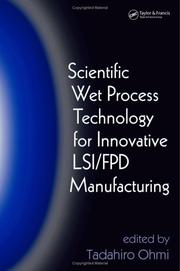 Scientific Wet Process Technology for Innovative LSI/FPD ManufacturingTadahiro Ohmi · 2005
 The museum environmentGarry Thomson · 1978
 Treaty Occupationay ToxicologySuelen Queiroz · 2010
 The Conspirators HierarchyJohn Coleman · 1992
Ranked by number of editions on Open Library, a rough measure of how lasting a book is.
🔗 Related topics
- Finishing (textiles) In textile manufacturing, finishing refers to the processes that convert the woven or knitted cloth into a usable material and more specifically to any…
- Dyeing Dyeing is the application of dyes or pigments on textile materials such as fibers, yarns, and fabrics with the goal of achieving color with desired color…
- Textile manufacturing Textile manufacturing or textile engineering is a major industry. It is largely based on the conversion of fibre into yarn, then yarn into fabric. These…
- Scouring (textiles) Scouring is a preparatory treatment of certain textile materials. Scouring removes soluble and insoluble impurities found in textiles as natural, added…
- Greige goods Greige goods (Gray goods, Grey goods, Corah or korā) are loom state woven fabrics, or unprocessed knitted fabrics. Greige goods undergo many subsequent…
- Textile printing Textile printing is the process of applying color to fabric in definite patterns or designs. In properly printed fabrics the colour is bonded with the…
- Ainsworth Mill, Breightmet Ainsworth Mill, Breightmet is a mercerising mill near the Breightmet neighborhood of Bolton, Greater Manchester. It was bought by the Lancashire Cotton…
- Calendering (textiles) Calendering of textiles is a finishing process used to smooth, coat, or thin a material. With textiles, fabric is passed between calender rollers at high…