Live briefing
Everything about WebDAV
HTTP extension for collaborative editing
WebDAV is a set of extensions to the Hypertext Transfer Protocol (HTTP) allowing user agents to collaboratively edit content directly in an HTTP server, which may act as a file server. It provides facilities for concurrency control and namespace operations, thus allowing the Web to be viewed as a writeable medium and not just a read-only medium. WebDAV is defined in RFC 4918 by a working group of the Internet Engineering Task Force (IETF). Wikipedia →
🧭 Start here: a 6-step reading path
- Read the overview: WebDAVA 5-minute orientation
- Skim a recent paper: Migration to WebDAV in Belle II ExperimentInfluential work since 2022
- Pick up a classic book: WebDAVThe most-reprinted book on the subject
- Read the landmark paper: WebDAV: IEFT standard for collaborative authoring on the WebCited 61 times
- Go sideways: CalDAVA closely related topic
- Go sideways: ICalendarA closely related topic
📖 Definitions
No dictionary entry for this exact phrase.
🏆 Landmark papers (most cited)
WebDAV: IEFT standard for collaborative authoring on the Web
World Wide Web distributed authoring and versioning (WebDAV)
The WebDAV property design
WebDAV: versatile collaboration multiprotocol
Collaborative Authoring on the Web: Introducing WebDAV
Extending WebDAV With Multiple-Granularity Locking
Instant certificate revocation and publication using WebDAV
Development of a WebDAV-based Smartphone Collaborative Application
🆕 Influential since 2022
📚 Books worth reading
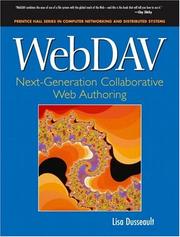 WebDAVLisa Dusseault · 2003
Ranked by number of editions on Open Library, a rough measure of how lasting a book is.
🔗 Related topics
- CalDAV Calendaring Extensions to WebDAV, or CalDAV, is an Internet standard allowing a client to access and manage calendar data along with the ability to schedule…
- ICalendar The Internet Calendaring and Scheduling Core Object Specification (iCalendar) is a media type which allows users to store and exchange calendaring and…
- List of HTTP status codes This article lists standard and notable non-standard HTTP response status codes. Standardized codes are defined by IETF as documented in Request for Comments…
- JSON Meta Application Protocol The JSON Meta Application Protocol (JMAP) is a set of related open Internet Standard protocols for handling email. JMAP is implemented using JSON APIs…
- SabreDAV sabre/dav is an open-source WebDAV server, developed by fruux and built in PHP. It is an implementation of the WebDAV protocol (with extensions for CalDAV…
- Webcal Webcal is a uniform resource identifier (URI) scheme for accessing iCalendar files. The webcal scheme was devised for use with the Apple iCal application…
- Network File System Network File System (NFS) is a distributed file system protocol originally developed by Sun Microsystems (Sun) in 1984, allowing a user on a client computer…
- HTTP 403 HTTP 403 is an HTTP status code meaning access to the requested resource is forbidden. The server understood the request, but will not fulfill it, even…