Live briefing

Everything about Walkability
How accessible a space is to walking
In urban planning, walkability is the accessibility of amenities within a reasonable walking distance. This concept is based on the idea that urban spaces should serve purposes beyond mere transport corridors designed for maximum vehicle throughput. Instead, the objective should be to create relatively complete, livable spaces that serve a variety of uses, users, and transportation modes, thereby reducing the need for cars for travel. The first of the ten principles of New Urbanism is walkability. Wikipedia →
🧭 Start here: a 6-step reading path
- Read the overview: WalkabilityA 5-minute orientation
- Skim a recent paper: Determinants and effects of perceived walkability: a literature review, conceptual model and research agendaInfluential work since 2022
- Pick up a classic book: Walkable CityThe most-reprinted book on the subject
- Read the landmark paper: Measuring the Unmeasurable: Urban Design Qualities Related to WalkabilityCited 1,388 times
- Go sideways: Living streetA closely related topic
- Go sideways: Healthy community designA closely related topic
📖 Definitions
Noun The quality of being walkable.
🏆 Landmark papers (most cited)
Measuring the Unmeasurable: Urban Design Qualities Related to Walkability
Many Pathways from Land Use to Health: Associations between Neighborhood Walkability and Active Transportation, Body Mass Index, and Air Quality
The development of a walkability index: application to the Neighborhood Quality of Life Study
Neighborhood Environment Walkability Scale
Walkability of local communities: Using geographic information systems to objectively assess relevant environmental attributes
Neighborhood Walkability and the Walking Behavior of Australian Adults
Validation of Walk Score® for Estimating Neighborhood Walkability: An Analysis of Four US Metropolitan Areas
What is a walkable place? The walkability debate in urban design
🆕 Influential since 2022
Determinants and effects of perceived walkability: a literature review, conceptual model and research agenda
Measuring visual walkability perception using panoramic street view images, virtual reality, and deep learning
The inclusive 15-minute city: Walkability analysis with sidewalk networks
GPS-based activity space exposure to greenness and walkability is associated with increased accelerometer-based physical activity
The 15-minute community life circle for older people: Walkability measurement based on service accessibility and street-level built environment – A case study of Suzhou, China
📚 Books worth reading
- 📕Walkable CityJennie Middleton · 2021
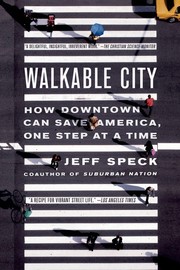 Walkable cityJeff Speck · 2012
- 📕Outdoor Lighting for PedestriansFrank Markowitz · 2021
- 📕Walkable WestchesterJane Daniels · 2009
 Creating walkable placesAdrienne Schmitz, Jason Scully · 2005
 Destination downtownEvan Stuart Rose · 1994
- 📕Walkable City RulesJeff Speck · 2018
- 📕The walkable cityMary Soderstrom · 2008
Ranked by number of editions on Open Library, a rough measure of how lasting a book is.
🔗 Related topics
- Living street A living street or residential street is a street designed with the interests of pedestrians and cyclists in mind. Living streets also act as social spaces…
- Healthy community design Healthy community design is planning and designing communities that make it easier for people to live healthy lives. Healthy community design offers important…
- Active mobility Active mobility, soft mobility, active travel, active transport or active transportation is the transport of people or goods, through non-motorized means…
- Pedestrian A pedestrian is a person traveling on foot (walking or running), by wheelchair or with other mobility aids. Streets and roads often have a designated footpath…
- Walkable city A walkable city or walking city is one that minimizes the need for vehicular transportation and encourages travel on foot. They are often characterized…
- Lawrence D. Frank Lawrence Douglas Frank (April 14, 1961) is an American and Canadian urban planner, researcher, and educator. Frank helped popularize the term walkability…
- Complete streets Complete streets is a transportation policy and design approach that requires streets to be planned, designed, operated and maintained to enable safe,…
- International Federation of Pedestrians The International Federation of Pedestrians (IFP) is a global network of non-profit organisations and individuals advocating for pedestrian rights, safe…