Everything about Verifiable computing
Verifiable computing enables a computer to offload the computation of some function, to other perhaps untrusted clients, while maintaining verifiable results. The other clients evaluate the function and return the result with a proof that the computation of the function was carried out correctly. The introduction of this notion came as a result of the increasingly common phenomenon of "outsourcing" computation to untrusted users in projects such as SETI@home and also to the growing desire to enable computationally-weak devices to outsource computational tasks to a more powerful computation service, as in cloud computing. The concept dates back to work by Babai et al., and has been studied under various terms, including "checking computations", "delegating computations", "certified computation", and verifiable computing. The term verifiable computing itself was formalized by Rosario Gennaro, Craig Gentry, and Bryan Parno, and echoes Micali's "certified computation". Wikipedia →
🧭 Start here: a 6-step reading path
- Read the overview: Verifiable computingA 5-minute orientation
- Skim a recent paper: VPFL: A verifiable privacy-preserving federated learning scheme for edge computing systemsInfluential work since 2022
- Pick up a classic book: C++ toolbox for verified computing IThe most-reprinted book on the subject
- Read the landmark paper: Verifiable Measurement-Only Blind Quantum Computing with Stabilizer TestingCited 172 times
- Go sideways: Verifiable secret sharingA closely related topic
- Go sideways: Goldwasser–Micali cryptosystemA closely related topic
📖 Definitions
No dictionary entry for this exact phrase.
🗂️ The subject at a glance
🏆 Landmark papers (most cited)
Verifiable Measurement-Only Blind Quantum Computing with Stabilizer Testing
Verifiable Auditing for Outsourced Database in Cloud Computing
Robustness and device independence of verifiable blind quantum computing
Efficient verifiable fuzzy keyword search over encrypted data in cloud computing
Secure and Verifiable Multikey Image Search in Cloud-Assisted Edge Computing
Towards achieving flexible and verifiable search for outsourced database in cloud computing
Privacy-Preserving and Verifiable Federated Learning Framework for Edge Computing
Verifiable Blind Quantum Computing with Trapped Ions and Single Photons
🆕 Influential since 2022
VPFL: A verifiable privacy-preserving federated learning scheme for edge computing systems
PPVerifier: A Privacy-Preserving and Verifiable Federated Learning Method in Cloud-Edge Collaborative Computing Environment
Self-Verifiable Attribute-Based Keyword Search Scheme for Distributed Data Storage in Fog Computing With Fast Decryption
Revocable Identity-Based Access Control for Big Data with Verifiable Outsourced Computing
MMDS: A secure and verifiable multimedia data search scheme for cloud-assisted edge computing
📚 Books worth reading
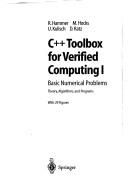 C++ toolbox for verified computing IRolf Hammer, Matthias Hocks · 1995
Ranked by number of editions on Open Library, a rough measure of how lasting a book is.
🔗 Related topics
- Verifiable secret sharing In cryptography, a secret sharing scheme is verifiable if auxiliary information is included that allows players to verify their shares as consistent. More…
- Goldwasser–Micali cryptosystem The Goldwasser–Micali (GM) cryptosystem is an asymmetric key encryption algorithm developed by Shafi Goldwasser and Silvio Micali in 1982. GM has the distinctio…
- Verifiable random function In cryptography, a verifiable random function (VRF) is a public-key pseudorandom function that provides proofs that its outputs were calculated correctly…
- Commitment scheme A commitment scheme is a cryptographic primitive that allows one to commit to a chosen value (or chosen statement) while keeping it hidden to others, with…
- Secure multi-party computation Secure multi-party computation (also known as secure computation, multi-party computation (MPC) or privacy-preserving computation) is a subfield of cryptography…
- Homomorphic encryption Homomorphic encryption is a form of encryption that allows computations to be performed on encrypted data without first having to decrypt it. The result…
- HEAAN HEAAN (Homomorphic Encryption for Arithmetic of Approximate Numbers) is an open source homomorphic encryption (HE) library which implements an approximate…
- Silvio Micali Silvio Micali (born October 13, 1954) is an Italian computer scientist, professor at the Massachusetts Institute of Technology and the founder of Algorand…