Live briefing
Everything about UDP-based Data Transfer Protocol
Protocol for high-speed data transfers
UDP-based Data Transfer Protocol (UDT), is a high-performance data transfer protocol designed for transferring large sized datasets over high-speed wide area networks. Such settings are typically disadvantageous for the more common TCP protocol. Wikipedia →
🧭 Start here: a 6-step reading path
- Read the overview: UDP-based Data Transfer ProtocolA 5-minute orientation
- Pick up a classic book: Computer NetworksThe most-reprinted book on the subject
- Go sideways: Fast and Secure ProtocolA closely related topic
- Go sideways: TCP congestion controlA closely related topic
📖 Definitions
No dictionary entry for this exact phrase.
🏆 Landmark papers (most cited)
- No matching papers found.
📚 Books worth reading
 Computer NetworksAndrew S. Tanenbaum, John David Wetherall · 1981
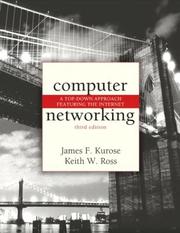 Computer networkingJames F. Kurose, Keith W. Ross · 1900
 TCP/IP IllustratedW. Richard Stevens, Kevin R. Fall · 1993
- 📕Tech15projects.com · 2014
Ranked by number of editions on Open Library, a rough measure of how lasting a book is.
🔗 Related topics
- Fast and Secure Protocol The Fast Adaptive and Secure Protocol (FASP) is a proprietary data transfer protocol. FASP is a network-optimized network protocol created by Michelle…
- TCP congestion control Transmission Control Protocol (TCP) uses one of several congestion control algorithms that include various aspects of an additive increase/multiplicative…
- Transmission Control Protocol The Transmission Control Protocol (TCP) is one of the main protocols of the Internet protocol suite, providing reliable, ordered, and error-checked delivery…
- Explicit Congestion Notification Explicit Congestion Notification (ECN) is an extension to the Internet Protocol and to the Transmission Control Protocol and is defined in RFC 3168 (2001)…
- Windows Vista networking technologies In computing, Microsoft's Windows Vista and Windows Server 2008 introduced in 2007/2008 a new networking stack named Next Generation TCP/IP stack, to improve…
- Transport layer In computer networking, the transport layer is an abstraction layer in a network protocol stack that provides communication services between applications…
- Keepalive A keepalive (KA) is a message sent by one device to another to check that the link between the two is operating, or to prevent the link from being broken…
- Tunneling protocol In computer networks, a tunneling protocol is a communication protocol that allows for the movement of data from one network to another. They can, for…