Live briefing

Everything about Telepathy
Psychic ability
Telepathy is the purported vicarious transmission of information from one person's mind to another's without using any known human sensory channels or physical interaction. The term was coined in 1882 by the classical scholar Frederic W. H. Myers, a founder of the Society for Psychical Research (SPR), and has remained more popular than the earlier expression thought-transference. Wikipedia →
🧭 Start here: a 6-step reading path
- Read the overview: TelepathyA 5-minute orientation
- Skim a recent paper: Writing telepathy back into marketing theoryInfluential work since 2022
- Pick up a classic book: Practical Mind ReadingThe most-reprinted book on the subject
- Read the landmark paper: Quantum Pseudo-TelepathyCited 163 times
- Go sideways: Ganzfeld experimentA closely related topic
- Go sideways: ParapsychologyA closely related topic
📖 Definitions
Noun The capability to communicate directly by psychic means; the sympathetic affection of one mind by the thoughts, feelings, or emotions of another at a distance, without communication through the ordinary channels of sensation.
🏆 Landmark papers (most cited)
Quantum Pseudo-Telepathy
Telepathy: Origins of Randomization in Experimental Design
ESP and ESB: Belief in personal success at mental telepathy.
Embodying Affect: Voice-hearing, Telepathy, Suggestion and Modelling the Non-conscious
Telepathy and Dreams: A Failure to Replicate
A psychological interpretation of the results of the Zenith radio experiments in telepathy.
Telepathy and Problems of Psychoanalysis
Telepathy in analysis
🆕 Influential since 2022
Writing telepathy back into marketing theory
Secure device-independent quantum bit-wise XOR summation based on a pseudo-telepathy game
Implementing 2-qubit pseudo-telepathy games on noisy intermediate-scale quantum computers
Rethinking communication and consciousness: Lessons from the telepathy tapes podcast
Gerda Walther and the Possibility of Telepathy as an Act of Personal Social Mind
📚 Books worth reading
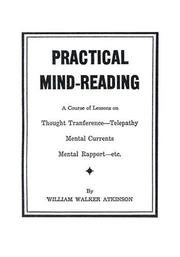 Practical Mind ReadingWilliam Walker Atkinson · 1908
 Dead Until Dark (Sookie Stackhouse, #1)Charlaine Harris · 2001
 The ChrysalidsJohn Wyndham · 1955
 The RowanAnne McCaffrey · 1990
 Mental Radio 1930Upton Sinclair · 1930
 Lateral thinking: creativity step by stepEdward de Bono, Alexandre Gombau Armau · 1970
 Touch Not the CatMary Stewart · 1976
 DamiaAnne McCaffrey · 1992
Ranked by number of editions on Open Library, a rough measure of how lasting a book is.
🔗 Related topics
- Ganzfeld experiment A ganzfeld experiment (from the German words for "entire" and "field") is an assessment used by parapsychologists that they contend can test for extrasensory…
- Parapsychology Parapsychology is the study of alleged psychic phenomena (extrasensory perception, telepathy, teleportation, precognition, clairvoyance, telekinesis, and…
- Extrasensory perception Extrasensory perception (ESP), also known as a sixth sense, or cryptaesthesia, is a claimed paranormal ability pertaining to reception of information not…
- Sensory leakage Sensory leakage is a term used to refer to information that transferred to a person by conventional, non-paranormal means during an experiment into extrasensory…
- Charles Honorton Charles Henry Honorton (February 5, 1946 – November 4, 1992) was an American parapsychologist and was one of the leaders of a collegial group of researchers…
- Outline of parapsychology Parapsychology is a field of research that studies a number of ostensible paranormal phenomena, including telepathy, precognition, clairvoyance, psychokinesis…
- C. E. M. Hansel Charles Edward Mark Hansel (12 October 1917 – 28 March 2011) was a British psychologist most notable for his criticism of parapsychological studies. Hansel…
- Clairvoyance Clairvoyance (/klɛərˈvɔɪ.əns/; from French clair 'clear' and voyance 'vision') is the claimed ability to acquire information that would be considered impossible…