Live briefing
Everything about Synchronous programming language
Programming language for programming reactive systems
A synchronous programming language is a computer programming language optimized for programming reactive systems. Wikipedia →
🧭 Start here: a 6-step reading path
- Read the overview: Synchronous programming languageA 5-minute orientation
- Skim a recent paper: Spacetime programming: a synchronous language for constraint searchInfluential work since 2022
- Pick up a classic book: Linguistische Aspekte der Synchronisation von FernsehserienThe most-reprinted book on the subject
- Read the landmark paper: The synchronous data flow programming language LUSTRECited 1,244 times
- Go sideways: SIGNAL (programming language)A closely related topic
- Go sideways: EsterelA closely related topic
📖 Definitions
No dictionary entry for this exact phrase.
🗂️ The subject at a glance
🏆 Landmark papers (most cited)
The synchronous data flow programming language LUSTRE
The Esterel synchronous programming language: design, semantics, implementation
Synchronous programming with events and relations: the SIGNAL language and its semantics
Programming and verifying real-time systems by means of the synchronous data-flow language LUSTRE
Computational model for distributed multimedia applications based on a synchronous programming language
The ClassiC programming language and design of synchronous concurrent object oriented languages
Synchronous Data Flow Programming with the Language SIGNAL
A memory-bounded, deterministic and terminating semantics for the synchronous programming language Céu
🆕 Influential since 2022
📚 Books worth reading
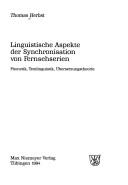 Linguistische Aspekte der Synchronisation von FernsehserienThomas Herbst · 1994
 Programming concurrency on the JVMVenkat Subramaniam · 2011
 Concurrency and synchronization in the INTEL iAPX-432 prototype systems implementation languageBruce J. MacLennan · 1983
- 📕11th IEEE Workshop on Real-Time Operating Systems and Software: Rtoss '94 : ProceedingsInstitute of Electrical and Electronics Engineers · 1994
Ranked by number of editions on Open Library, a rough measure of how lasting a book is.
🔗 Related topics
- SIGNAL (programming language) SIGNAL is a programming language based on synchronized dataflow (flows + synchronization): a process is a set of equations on elementary flows describing…
- Esterel Esterel is a synchronous programming language for the development of complex reactive systems. The imperative programming style of Esterel allows the simple…
- Globally asynchronous locally synchronous Globally asynchronous locally synchronous (GALS), in electronics, is an architecture for designing electronic circuits that addresses the problem of safe…
- Lustre (programming language) Lustre is a formally defined, declarative, and synchronous dataflow programming language for programming reactive systems. It began as a research project…
- Join-pattern Join-patterns provides a way to write concurrent, parallel and distributed computer programs by message passing. Compared to the use of threads and locks…
- Communicating sequential processes In computer science, communicating sequential processes (CSP) is a formal language for describing patterns of interaction in concurrent systems. It is…
- Asynchronous circuit Asynchronous circuit (clockless or self-timed circuit) is a sequential digital logic circuit that does not use a global clock circuit or signal generator…
- Reo Coordination Language Reo is a domain-specific language for programming and analyzing coordination protocols that compose individual processes into full systems, broadly construed…