Live briefing
Everything about Statics
Branch of mechanics concerned with balance of forces in nonmoving systems
Statics is the branch of classical mechanics that is concerned with the analysis of force and torque acting on a physical system that does not experience an acceleration, but rather is in equilibrium with its environment. Wikipedia →
🧭 Start here: a 6-step reading path
- Read the overview: StaticsA 5-minute orientation
- Skim a recent paper: Statics and dynamics of skyrmions interacting with disorder and nanostructuresInfluential work since 2022
- Pick up a classic book: Engineering Mechanics, StaticsThe most-reprinted book on the subject
- Read the landmark paper: Wetting: statics and dynamicsCited 6,695 times
- Go sideways: Rigid body dynamicsA closely related topic
- Go sideways: Net forceA closely related topic
📖 Definitions
Noun The branch of mechanics concerned with forces in static equilibrium
🗂️ The subject at a glance
🏆 Landmark papers (most cited)
Wetting: statics and dynamics
Monotone Comparative Statics
Statics and dynamics of worm-like surfactant micelles
Gradient elasticity in statics and dynamics: An overview of formulations, length scale identification procedures, finite element implementations and new results
Statics and Dynamics of Continuum Robots With General Tendon Routing and External Loading
Thermoreversible Gelation in Solutions of Associative Polymers. 1. Statics
An accurate, simple theory of the statics and dynamics of elastic plates
From crystal statics to chemical dynamics
🆕 Influential since 2022
Statics and dynamics of skyrmions interacting with disorder and nanostructures
Topology Optimization: A Review for Structural Designs Under Statics Problems
Statics and Dynamics of Continuum Robots Based on Cosserat Rods and Optimal Control Theories
Fundamentals of Curvilinear Ferromagnetism: Statics and Dynamics of Geometrically Curved Wires and Narrow Ribbons
Non-Hermitian higher-order topological superconductors in two dimensions: Statics and dynamics
📚 Books worth reading
 Engineering Mechanics, StaticsR. C. Hibbeler · 1920
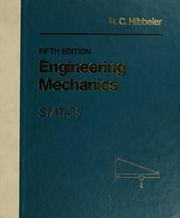 Engineering Mechanics, Statics & DynamicsR. C. Hibbeler · 1974
 Vector Mechanics for Engineers, DynamicsFerdinand Pierre Beer, E. Russell Johnston, Jr. · 1962
 Vector Mechanics for Engineers, StaticsFerdinand Pierre Beer, E. Russell Johnston, Jr. · 1962
 Vector Mechanics for Engineers, Statics & DynamicsFerdinand Pierre Beer, E. Russell Johnston, Jr. · 1962
 Engineering mechanicsA. Bedford, Anthony Bedford · 1998
 Engineering mechanicsJ. L. Meriam, L. G. Kraige · 1978
 Engineering mechanicsAndrew Pytel, Jaan Kiusalaas · 1978
Ranked by number of editions on Open Library, a rough measure of how lasting a book is.
🔗 Related topics
- Rigid body dynamics In classical mechanics, rigid body dynamics studies the movement of systems of interconnected bodies under the action of external forces. Along with statics…
- Net force In mechanics, the net force is the sum of all the forces acting on an object. For example, if two forces are acting upon an object in opposite directions…
- Couple (mechanics) In physics, a couple is a pair of forces that are equal in magnitude but opposite in their direction of action. A couple produces a pure rotational motion…
- Torque In physics and mechanics, torque is the rotational correspondent of linear force. It is also referred to as the moment of force, or simply the moment.…
- Free body diagram In physics and engineering, a free body diagram (FBD; also called a force diagram) is a graphical illustration used to visualize the applied forces, moments…
- Rotation around a fixed axis Rotation around a fixed axis or axial rotation is a special case of rotational motion around an axis of rotation fixed, stationary, or static in three-dimension…
- Force In physics, a force is an action that can cause an object to change its velocity or its shape, or to resist other forces, or to cause changes of pressure…
- Moment of inertia The moment of inertia (also known as mass moment of inertia, angular/rotational mass, second moment of mass, or rotational inertia) is a measure of how…