Live briefing

Everything about Space-time adaptive processing
Signal processing technique used in radar
Space-time adaptive processing (STAP) is a signal processing technique most commonly used in radar systems. It involves adaptive array processing algorithms to aid in target detection. Radar signal processing benefits from STAP in areas where interference is a problem. Through careful application of STAP, it is possible to achieve order-of-magnitude sensitivity improvements in target detection. Wikipedia →
🧭 Start here: a 6-step reading path
- Read the overview: Space-time adaptive processingA 5-minute orientation
- Skim a recent paper: Multi-Spectrally Constrained Low-PAPR Waveform Optimization for MIMO Radar Space-Time Adaptive ProcessingInfluential work since 2022
- Pick up a classic book: Space-Time Adaptive Processing for Radar (Artech House Radar Library)The most-reprinted book on the subject
- Read the landmark paper: On Using a priori Knowledge in Space-Time Adaptive ProcessingCited 220 times
- Go sideways: PrecodingA closely related topic
- Go sideways: Channel state informationA closely related topic
📖 Definitions
No dictionary entry for this exact phrase.
🗂️ The subject at a glance
🏆 Landmark papers (most cited)
On Using a priori Knowledge in Space-Time Adaptive Processing
Space-Time-Range Adaptive Processing for Airborne Radar Systems
Polyphase Waveform Design for MIMO Radar Space Time Adaptive Processing
Introduction to space-time adaptive processing
Knowledge-Aided Space-Time Adaptive Processing
A subspace method for space time adaptive processing
Bistatic FDA-MIMO radar space-time adaptive processing
Knowledge-Aided Bayesian Space-Time Adaptive Processing
🆕 Influential since 2022
Multi-Spectrally Constrained Low-PAPR Waveform Optimization for MIMO Radar Space-Time Adaptive Processing
Tensor-Based Sparse Recovery Space-Time Adaptive Processing for Large Size Data Clutter Suppression in Airborne Radar
A Parametric Approach to Space-Time Adaptive Processing in Bistatic Radar Systems
Space–Time Adaptive Processing Using Deep Neural Network-Based Shrinkage Algorithm Under Small Training Samples
Space-Time Adaptive Processing via Random Matrix Theory for Finite Training Samples
📚 Books worth reading
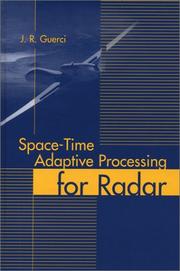 Space-Time Adaptive Processing for Radar (Artech House Radar Library)J. R. Guerci · 2003
Ranked by number of editions on Open Library, a rough measure of how lasting a book is.
🔗 Related topics
- Precoding In signal processing, precoding is a generalization of beamforming to support multi-stream (or multi-layer) transmission in multi-antenna wireless communication…
- Channel state information In wireless communications, channel state information (CSI) is the known channel properties of a communication link. This information describes how a signal…
- Extended Kalman filter In estimation theory, the extended Kalman filter (EKF) is the nonlinear version of the Kalman filter which linearizes about an estimate of the current…
- MIMO MIMO (/ˈmaɪmoʊ, ˈmiːmoʊ/), or multiple-input multiple-output, is a wireless technology that multiplies the capacity of a radio link using multiple transmit…
- Ensemble Kalman filter The ensemble Kalman filter (EnKF) is a recursive filter suitable for problems with a large number of variables, such as discretizations of partial differential…
- Singular spectrum analysis In time series analysis, singular spectrum analysis (SSA) is a nonparametric spectral estimation method. It combines elements of classical time series…
- MUSIC (algorithm) MUSIC (MUltiple SIgnal Classification) is an algorithm used for frequency estimation and radio direction finding. In many practical signal processing problems…
- Bayesian interpretation of kernel regularization Bayesian interpretation of kernel regularization examines how kernel methods in machine learning can be understood through the lens of Bayesian statistics…