Everything about Sovereignty
Supreme authority within a territory

Sovereignty is generally defined as supreme, independent control and lawmaking authority over a territory. It is expressed through the power to rule and make law. Sovereignty entails hierarchy within a state as well as external autonomy, which refers to the ability of a state to act independently in international affairs. In any state, sovereignty is assigned to the person, body or institution that has the ultimate authority over its citizens and the power to modify existing laws. In political theory, sovereignty is a substantive term designating supreme legitimate authority over some polity. Wikipedia →
🧭 Start here: a 6-step reading path
- Read the overview: SovereigntyA 5-minute orientation
- Skim a recent paper: Technology sovereignty as an emerging frame for innovation policy. Defining rationales, ends and meansInfluential work since 2022
- Pick up a classic book: The anatomy of peaceThe most-reprinted book on the subject
- Read the landmark paper: The agroecological revolution in Latin America: rescuing nature, ensuring food sovereignty and empowering peasantsCited 986 times
- Go sideways: Sovereign stateA closely related topic
- Go sideways: The Six Books of the RepublicA closely related topic
📖 Definitions
Noun The quality or state of being sovereign.
Noun Of a ruler (especially a monarch): supreme authority or dominion over something.
Noun Of a nation or other polity: the state of being able to control resources, make laws independently, and otherwise govern itself without the coercion or concurrence of other polities.
Noun Of a person: the liberty to decide one's actions and thoughts.
🗂️ The subject at a glance
🏆 Landmark papers (most cited)
The agroecological revolution in Latin America: rescuing nature, ensuring food sovereignty and empowering peasants
Slow Death (Sovereignty, Obesity, Lateral Agency)
Food sovereignty
Agroecologically efficient agricultural systems for smallholder farmers: contributions to food sovereignty
Sovereignty, International Relations, and the Westphalian Myth
Critical Culturally Sustaining/Revitalizing Pedagogy and Indigenous Education Sovereignty
Making room and moving over: knowledge co-production, Indigenous knowledge sovereignty and the politics of global environmental change decision-making
Sovereignty Regimes: Territoriality and State Authority in Contemporary World Politics
🆕 Influential since 2022
Technology sovereignty as an emerging frame for innovation policy. Defining rationales, ends and means
Moving on to not fall behind? Technological sovereignty and the ‘geo-dirigiste’ turn in EU industrial policy
Digital/sovereignty and European security integration: an introduction
EU AI sovereignty: for whom, to what end, and to whose benefit?
Contested Spatialities of Digital Sovereignty
📚 Books worth reading
 The anatomy of peaceEmery Reves, E. Reves · 1659
 Turner Diaries (Audio)Andrew MacDonald, William Luther Pierce · 1980
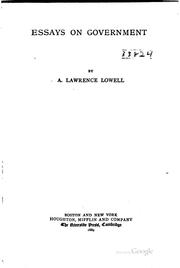 Essays on governmentA. Lawrence Lowell · 1889
 SovereigntyBertrand de Jouvenel · 1957
- 📕Giraldi Cambrensis operaGiraldus Cambrensis · 1861
 Imagined regional communitiesJames D. Sidaway · 2001
 The first two years of KansasGeorge Washington Martin · 1907
 Sovereignty in fragmentsHent Kalmo, Quentin Skinner · 2010
Ranked by number of editions on Open Library, a rough measure of how lasting a book is.
🔗 Related topics
- Sovereign state A sovereign state is a state that has sovereignty, that is, the highest authority over a territory. It is commonly understood that a sovereign state is…
- The Six Books of the Republic The Six Books of the Republic or Six Books of the Commonwealth (original title in French: Les Six Livres de la République) is a work of political philosophy…
- Popular sovereignty in the United States Popular sovereignty is the principle that the leaders of a state and its government are created and sustained by the consent of its people, who are the…
- Westphalian system The Westphalian system, also known as Westphalian sovereignty, is a principle in international law that each state has exclusive sovereignty over its territory…
- Independence Independence is a condition of a nation, country, or state, in which residents and population, or some portion thereof, exercise self-government, and usually…
- Military occupation Military occupation, also called belligerent occupation or simply occupation, is temporary hostile control exerted by a ruling power's military apparatus…
- Territorial dispute A territorial dispute is a geopolitical phenomenon in which two or more political entities lack consensus on borders and sovereignty anywhere over land…
- Legal status of Germany The legal status of Germany concerns the question of the extinction, or otherwise continuation according to the rules of state succession, of the German…