Live briefing
Everything about Source reduction
Approach to pollution prevention
Source reduction is the activities designed to reduce the volume, mass, or toxicity of products throughout the life cycle. It includes the design and manufacture, use, and disposal of products with minimal toxic content, minimal material volume, and/or a longer useful life. Wikipedia →
🧭 Start here: a 6-step reading path
- Read the overview: Source reductionA 5-minute orientation
- Skim a recent paper: Visible-Light Photocatalytic Reduction of Aryl Halides as a Source of Aryl RadicalsInfluential work since 2022
- Pick up a classic book: Somebody Else's ProblemThe most-reprinted book on the subject
- Read the landmark paper: Source composite curve for waste reductionCited 177 times
- Go sideways: Waste minimisationA closely related topic
- Go sideways: Waste hierarchyA closely related topic
📖 Definitions
No dictionary entry for this exact phrase.
🗂️ The subject at a glance
🏆 Landmark papers (most cited)
Source composite curve for waste reduction
Source and reduction of nitrous oxide
Microbial Reduction of Structural Iron in Clays—A Renewable Source of Reduction Capacity
Biological Sulfate Reduction Using Molasses as a Carbon Source
Hazardous waste source reduction in materials and processing technologies
Promoting Source Reduction Behavior
Harmonics Reduction in Current Source Converters Using Fuzzy Logic
REDUCTION OF HARMONIC DISTORTION IN VIBRATORY SOURCE RECORDS*
🆕 Influential since 2022
Visible-Light Photocatalytic Reduction of Aryl Halides as a Source of Aryl Radicals
Natural resources as a source of financing energy poverty reduction? Resources extraction perspective
Recent advancements in source reduction and recycling technologies for converter dust
GHG emissions reduction patterns from waste sectors after forced source separation
A Quasi-Z-Source-Based Five-Level PV Inverter With Leakage Current Reduction
📚 Books worth reading
 Somebody Else's ProblemRobert Crocker · 2015
- 📕Resource Efficiency Complexity and the CommonsBruce Lankford · 2013
- 📕Waste Prevention Policy and BehaviourAna Paula Bortoleto · 2014
- 📕Waste management and valorizationElena Cristina Rada · 2015
- 📕Resource Recovery to Approach Zero Municipal WasteMohammad J. Taherzadeh, Tobias Richards · 2015
 Circular Economy for the Management of OperationsAnil Kumar, Jose Arturo Garza-Reyes · 2020
- 📕Waste management and sustainable consumptionKarin M. Ekström · 2014
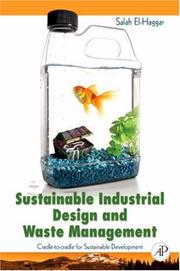 Sustainable Industrial Design and Waste ManagementSalah El Haggar · 2007
Ranked by number of editions on Open Library, a rough measure of how lasting a book is.
🔗 Related topics
- Waste minimisation Waste minimisation is a set of processes and practices intended to reduce the amount of waste produced. By reducing or eliminating the generation of harmful…
- Waste hierarchy The waste management hierarchy, waste hierarchy, or "hierarchy of waste management options", is a tool used in the evaluation of processes that protect…
- Zero waste Zero waste, or waste minimization, is a set of principles focused on waste prevention that encourages redesigning resource life cycles so that all products…
- Design for the environment Design for the environment (DfE) is a design approach to reduce the overall human health and environmental impact of a product, process or service, where…
- Plastic bag A plastic bag, poly bag, or pouch is a type of container made of thin, flexible, plastic film, nonwoven fabric, or plastic textile. Plastic bags are used…
- Sustainable packaging Sustainable packaging refers to the design, manufacture and use of packaging with the aim of reducing environmental impacts over its life cycle while maintainin…
- City of Oakland's Zero Waste Program The City of Oakland, California, adopted a Zero Waste Strategic Plan in 2006, detailing a road map for the city to follow toward the implementation of…
- Packaging waste Packaging waste, the part of the waste that consists of packaging and packaging material, is a major part of the total global waste, and the major part…