Everything about Slang
Vocabulary of an informal register
Slang is a vocabulary of an informal register, common in everyday conversation but avoided in formal writing and speech. It also often refers to the language exclusively used by the members of particular in-groups in order to establish group identity, exclude outsiders, or both. The word itself came about in the 18th century and has been defined in multiple ways since its conception, with no single technical usage in linguistics. Wikipedia →
🧭 Start here: a 6-step reading path
- Read the overview: SlangA 5-minute orientation
- Skim a recent paper: Long‐read genotyping with SLANG (Simple Long‐read loci Assembly of Nanopore data for Genotyping)Influential work since 2022
- Pick up a classic book: A dictionary of slang and unconventional EnglishThe most-reprinted book on the subject
- Read the landmark paper: “It isn't no slang that can be said about this stuff”: Language, identity, and appropriating science discourseCited 160 times
- Go sideways: ColloquialismA closely related topic
- Go sideways: CantA closely related topic
📖 Definitions
Noun Language outside of conventional usage and in the informal register.
Noun Language that is unique to a particular profession or subject; jargon.
Noun The specialized language of a social group, sometimes used to conceal one's meaning from outsiders; cant.
Noun A particular variety of slang; the slang used by a particular group.
🏆 Landmark papers (most cited)
“It isn't no slang that can be said about this stuff”: Language, identity, and appropriating science discourse
Adding Spice to the Porridge11‘Porridge’ is British slang for a prison sentence. E.g. ‘Doing his porridge’. The term is most commonly thought to be an allusion to the fact that porridge is, or used to be, a common food in prison. The term is also thought to be a pun on the much older slang word for prison, ‘stir’.: The development of a synthetic cannabinoid market in an English prison
Those Naughty Teenage Girls: Japanese Kogals, Slang, and Media Assessments
Appropriation of African American slang by Asian American youth1
“I'll speak in proper slang”: Language ideologies in a daily editing activity
“Arabizi”: A Contemporary Style of Arabic Slang
“Snatch,” “Hole,” or “Honey‐pot”? Semantic categories and the problem of nonspecificity in female genital slang
Is Slang a Word for Linguists?
🆕 Influential since 2022
Long‐read genotyping with SLANG (Simple Long‐read loci Assembly of Nanopore data for Genotyping)
Machine Learning Model for Offensive Speech Detection in Online Social Networks Slang Content
Investigating translanguaging strategies and online self-presentation through internet slang on Douyin (Chinese TikTok)
Translating Idioms and Slang: Problems, Strategies, and Cultural Implications
A Systematic Literature Review on Social Media Slang Analytics in Contemporary Discourse
📚 Books worth reading
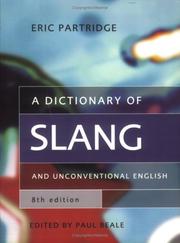 A dictionary of slang and unconventional EnglishEric Partridge · 1900
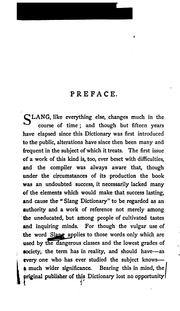 The slang dictionary: etymological, historical, and anecdotalJohn Camden Hotten · 1864
 Made in AmericaBill Bryson · 1994
 Slang to-day and yesterdayEric Partridge · 1933
 A collection of college words and customsBenjamin Homer Hall · 1851
 Smaller slang dictionaryEric Partridge · 1961
- 📕Dictionnaire de l'argot moderneGéo Sandry · 1953
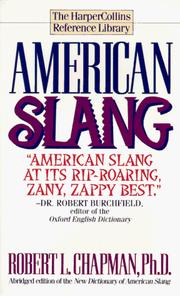 American SlangRobert L. Chapman, Barbara Ann Kipfer · 1987
Ranked by number of editions on Open Library, a rough measure of how lasting a book is.
🔗 Related topics
- Colloquialism Colloquialism (also called colloquial language, everyday language, or general parlance) is the linguistic style used for casual (informal) communication…
- Cant A cant is the jargon or language of a group, often employed to exclude or mislead people outside the group. It may also be called a cryptolect, argot,…
- Jargon Jargon, or technical language, is the specialized terminology associated with a particular field or area of activity. Jargon is normally employed in a…
- Neologism In linguistics, a neologism (/niˈɒlədʒɪzəm/, /ˌniːoʊˈloʊ-/; also known as a coinage) is any newly formed word, term, or phrase that has gained popular…
- Thieves' cant Thieves' cant (also known as thieves' argot, rogues' cant, or peddler's French) is a cant, cryptolect, or argot which was formerly used by thieves, beggars…
- Internet slang Internet slang (also known as internet shorthand, cyber-slang, netspeak, or digispeak) is a non-standard or unofficial form of language used by people…
- Wasei-eigo Wasei-eigo (和製英語; lit. 'Japanese-made English') are Japanese-language expressions that are based on English words, or on parts of English phrases, but…
- Register (sociolinguistics) In sociolinguistics, a register is a variety of language used for a particular purpose or particular communicative situation. For example, when speaking…