Everything about Signal
Varying physical quantity that conveys information

A signal is both the process and the result of transmission of data over some media accomplished by embedding some variation. Signals are important in multiple subject fields, including signal processing, information theory and biology. Wikipedia →
🧭 Start here: a 6-step reading path
- Read the overview: SignalA 5-minute orientation
- Skim a recent paper: SignalP 6.0 predicts all five types of signal peptides using protein language modelsInfluential work since 2022
- Pick up a classic book: Detection, estimation, and modulation theoryThe most-reprinted book on the subject
- Read the landmark paper: A theory for multiresolution signal decomposition: the wavelet representationCited 17,052 times
- Go sideways: Digital signalA closely related topic
- Go sideways: Analog signalA closely related topic
📖 Definitions
Noun A sequence of states representing an encoded message in a communication channel.
Noun Any variation of a quantity or change in an entity over time that conveys information upon detection.
Noun A sign made to give notice of some occurrence, command, or danger, or to indicate the start of a concerted action.
Noun An on-off light, semaphore, or other device used to give an indication to another person. A railway signal.
🗂️ The subject at a glance
🏆 Landmark papers (most cited)
A theory for multiresolution signal decomposition: the wavelet representation
Robust uncertainty principles: exact signal reconstruction from highly incomplete frequency information
Multiple emitter location and signal parameter estimation
REACTIVE OXYGEN SPECIES: Metabolism, Oxidative Stress, and Signal Transduction
Signal Recovery From Random Measurements Via Orthogonal Matching Pursuit
SignalP 4.0: discriminating signal peptides from transmembrane regions
ESPRIT-estimation of signal parameters via rotational invariance techniques
Signal integration in the endoplasmic reticulum unfolded protein response
🆕 Influential since 2022
SignalP 6.0 predicts all five types of signal peptides using protein language models
Targeting TGF-β signal transduction for fibrosis and cancer therapy
An Overview of Signal Processing Techniques for RIS/IRS-Aided Wireless Systems
Edge Learning for B5G Networks With Distributed Signal Processing: Semantic Communication, Edge Computing, and Wireless Sensing
Mitochondrial signal transduction
📚 Books worth reading
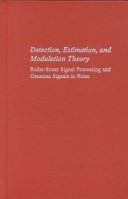 Detection, estimation, and modulation theoryHarry L. Van Trees, Harry L.Van Trees · 1968
 Signals and SystemsAlan V. Oppenheim, Alan S. Willsky · 1983
 Discrete-time signal processingAlan V. Oppenheim, Ronald Schafer · 1975
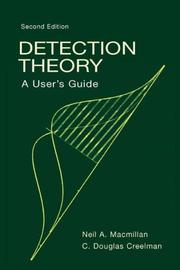 Detection theoryNeil A. Macmillan, C. Douglas Creelman · 2004
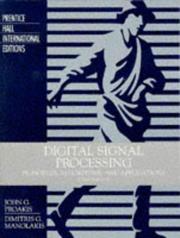 Digital signal processingJohn G. Proakis, Dimitris K Manolakis · 1992
 Fundamentals of Signals and Systems Using the Web and MatlabEdward W. Kamen, Bonnie S. Heck · 2000
 Analog electronicsIan Hickman · 1990
 Digital signal processingSanjit Kumar Mitra · 1998
Ranked by number of editions on Open Library, a rough measure of how lasting a book is.
🔗 Related topics
- Digital signal A digital signal is a signal that represents data as a sequence of discrete values; at any given time it can only take on, at most, one of a finite number…
- Analog signal An analog signal (American English) or analogue signal (British and Commonwealth English) is any signal, typically a continuous-time signal, representing…
- Discrete time and continuous time In mathematical dynamics, discrete time and continuous time are two alternative frameworks within which variables that evolve over time are modeled. Discrete…
- Signal processing Signal processing is an electrical engineering subfield that focuses on analyzing, modifying and synthesizing signals, such as sound, images, potential…
- Analogue electronics Analogue electronics (American English: analog electronics) are electronic systems with a continuously variable signal, in contrast to digital electronics…
- Analog signal processing Analog signal processing is a type of signal processing conducted on continuous analog signals by some analog means (as opposed to the discrete digital…
- Digital-to-analog converter In electronics, a digital-to-analog converter (DAC, D/A, D2A, or D-to-A) is a system that converts a digital signal into an analog signal. An analog-to-digital…
- Sampling (signal processing) In signal processing, sampling is the reduction of a continuous-time signal to a discrete-time signal. A common example is the conversion of a sound wave…